
Parking, bag policy, transit and history are on the main Spectrum Center guide.
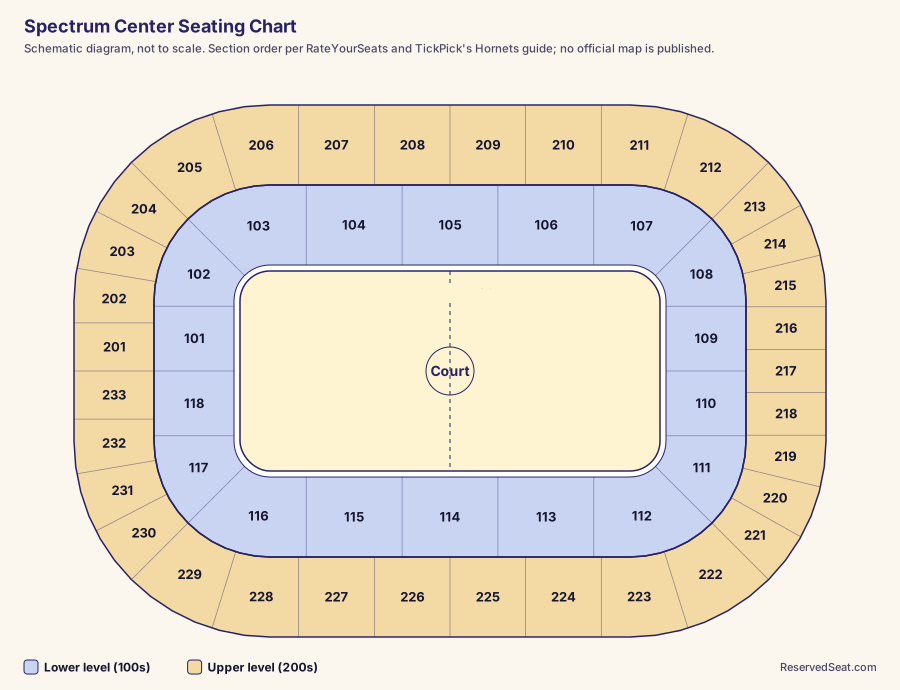
How to read the Spectrum Center seating chart
The Spectrum Center seating chart has two main rings: a lower level of sections 101 through 118 and an upper level of sections 201 through 233, with the Founders Level suites and lounges between them. Center court sits at sections 105 and 114 downstairs and at 208–209 and 225–226 upstairs. For a Hornets game, the best all-around seats are the middle rows of 104–106 and 113–115; the best value is rows A through E of the four upper center sections.
If you saved a Time Warner Cable Arena or Charlotte Bobcats Arena chart, it still points to the same bowl. The building changed names in 2008 and 2016, but section numbers carried over, so a ticket or seat-view photo labeled with an old name matches the seats you would sit in today.
- Closest: courtside rows on the floor, then the first lettered rows of the center sideline sections.
- Best balance: 104–106 and 113–115, roughly the middle third of the rows.
- Best value: low rows of 208, 209, 225 and 226.
- Think twice: upper-level sections angled toward the baskets, and any section beside or behind a concert stage.
Section numbers, ends and sidelines
Section ranges here come from the RateYourSeats section directory, and the TickPick Hornets guide confirms the center sections and bench locations. Both rings work the same way: numbering starts at one baseline (101 and 201), runs down one sideline, turns the far end and comes back along the other sideline, so the first and last sections of each ring meet behind the same basket.
100 level: sections 101–118
Sections 101 and 118 share one baseline, and 109 and 110 share the other. RateYourSeats notes a quirk worth knowing: a stairway splits each baseline, so no section sits dead center behind a basket. The sideline blocks are 104–106 on the Hornets' bench side and 113–115 across the floor, with 105 and 114 at midcourt. TickPick points out that 101–103 and 116–117 are noticeably larger than the corner sections on the opposite end, so a given row letter is not directly comparable from one corner to another.
200 level: sections 201–233
Sections 201 and 233 sit at one end and 215–219 at the other. RateYourSeats places 207–210 on the north sideline and 224–227 on the south. The east-end sections 216–218 are small, and 215–219 are near the arena's family fan zone, which makes them a practical choice with children.
Row letters, row depth and where seat 1 is
Seat numbering. Two seating guides agree on the rule. TickPick states that the lowest seat number in a section sits next to the neighboring lower-numbered section; RateYourSeats states that seat 1 is on your right as you face the court. In section 114, for example, seat 1 is on the right aisle beside section 113, and the high numbers sit against 115. That makes aisle seats easy to pick from a listing: the lowest and highest numbers in a row are the aisle ends.
Row letters. Lower-level rows start with courtside and front rows and then run alphabetically up the section. The two guides label the courtside rows differently: RateYourSeats shows rows CS1 through CS4 in front of the sideline sections, while TickPick and older listings call them A1 through A5. Either way, row A is several rows up from the floor in the center sections, not the front row.
Row depth. One guide, RateYourSeats, publishes row lists for every section; no second source confirms them, so treat the following as approximate. It shows the center sideline sections running to about row R or V, the large corner sections running into double letters (AA to EE), and the upper sideline sections 206–211 and 223–228 running from A to X, with the tunnel entrance at row E. The upper end sections are far shallower.
- Upper rows A–D: below the tunnel, closest to the court, and the rows both guides single out as the level's best.
- Upper rows above E: a climb, and the sideline sections there are among the widest in the league, so expect to pass many seats to reach the aisle.
Best seats for a Hornets game
Two guides place the Hornets' bench in front of section 104 and the visitors' bench in front of 106, with the scorer's table between them at 105. That means 104–106 look across at the broadcast side, and 113–115 look back at both benches.
- Courtside: the floor rows in front of the sideline and baseline sections, which carry access to the HondaJet Courtside Club per the team's premium seating materials.
- Inner Circle Club: the front rows of select 100-level sections, sold with an all-inclusive club, according to RateYourSeats.
- Pick: 105 and 114 from the middle rows up. You sit high enough to clear courtside heads and close enough to hear the game.
- Behind the bench: 104 for the Hornets, 106 for the visitors.
- Baseline value: because the baselines are split by a stairway, the end sections are better than at many arenas. A higher row helps you see the far basket.
- Upper pick: 208, 209, 225 and 226. RateYourSeats says these four are the only upper sections with no basket in the sightline. In the rest of the 200 level, the backboard blocks part of the court from some seats.
- Think twice: upper corners nearest the sideline, such as 206 and 228, which RateYourSeats rates as awkward angles; the inner corners such as 229 and 230 look more directly across the court.
Concert layouts and the floor
For most end-stage concerts, per RateYourSeats, the stage goes up at the end nearest sections 107–112, and the floor is divided into six reserved sections, Floor 1 through Floor 6, each about 20 rows deep with row A at the front. Some shows sell the floor as general admission instead, so read your ticket. Tours bring their own stage designs, so the map for your show is the final word.
- Head-on views: the far end of the bowl, 101–103 and 116–118 downstairs and 230–233 and 201–204 upstairs, looks straight at the stage.
- Close side views: 113–115 and 104–106, the sideline blocks; RateYourSeats calls 114 one of the best lower sections for concerts, with a clean side angle.
- Avoid or check: 108–111 downstairs and roughly 211–223 upstairs sit beside or behind the stage for most concerts and may be closed or sold with limited views.
- On the floor: the floor is flat, so a front row of a rear floor section can beat the back rows of the front one.
Concert capacity changes with the stage, from a 180-degree end stage to a full 360-degree setup, so the number of sections on sale varies from show to show.
The view from each level
Fans searching for a Spectrum Center seat view are usually choosing between three heights.
- Floor and courtside: eye level with the players. You see faces and footwork, but the far end of the court is foreshortened and the scoreboard overhead is a better guide to the score.
- 100 level, middle rows: the reference view. From row J or so of 105 or 114 you see both baskets, the benches and the play developing, the same angle TV uses.
- 100 level, top rows: rows near the top of 107–112 hold the table and drink-rail seating (row TB2 in those sections, per RateYourSeats), with a raised look over the court and quick access to the concourse.
- 200 level, rows A–E: high but surprisingly usable, especially at center court, where the view of plays forming is better than from a low corner.
- 200 level, top rows: the full bowl and the videoboard; the players look small and the basket can intrude at the ends.
Clubs, suites and accessible seating
The arena's own guide places the Bank of America Hardwood Club, the HondaJet Courtside Club, the Lexus Lounge and the Inner Circle Club on the Honeywell Event Level, the floor level that serves the courtside and hardwood seats. The Novant Health Suite Level holds the standard, mini and party suites, the Super Suite and the First Horizon Bank Theater Box. The Founders Level between the rings has the Founders Suites, which RateYourSeats numbers F1 through F17 along the sidelines.
Accessible seating. Spectrum Center sells wheelchair-accessible and companion seats throughout the arena, subject to availability, and recommends picking the accessible option as soon as a sale begins. The venue does not publish a section list. Both seating guides describe accessible rows at the top of most sections, and RateYourSeats notes wheelchair positions in front of row B in section 107. Guests with disabilities can use the elevator directly inside the Trade Street main entrance. Read the arena's accessible seating page before you buy.
Frequently asked questions
How are seats numbered at Spectrum Center?
Seat 1 is on your right as you face the court, next to the neighboring lower-numbered section, and numbers climb toward the next section. Two seating guides, TickPick and RateYourSeats, describe the same rule.
What does the view look like from the Spectrum Center upper level?
From rows A to E of center sections 208, 209, 225 and 226 you see the whole court with no basket in the way. Higher rows and the end sections are farther away, and the backboard blocks part of the court from some seats.
How many rows are in a Spectrum Center section?
It varies. RateYourSeats shows center lower sections running to about row R or V, big corner sections into double letters, and upper sideline sections from row A to X. Row A in the center lower sections sits behind several courtside rows.
Where is the Hornets bench at Spectrum Center?
In front of section 104, with the visitors in front of 106 and center court at 105, per both TickPick and RateYourSeats.
Is the Time Warner Cable Arena seating chart the same as Spectrum Center?
Yes. It is the same building and the same section numbers. It opened as Charlotte Bobcats Arena, became Time Warner Cable Arena in 2008 and Spectrum Center in 2016.
Which Spectrum Center sections have accessible seating?
The arena sells wheelchair and companion seats throughout the building but does not publish a section list. Seating guides place accessible rows at the top of most sections; choose the accessible option when you buy.