
.jpg)
Upcoming events at Ambassador Theatre
Dates and live ticket listings appear here as soon as they are on sale. The guide below covers what to know before you buy.
Where to sit, in brief
For Chicago at the Ambassador Theatre, buy center orchestra between roughly rows E and M, or the front center mezzanine. Avoid the extreme side seats on either level and the back of the orchestra under the overhang unless the price makes up for it. The rear mezzanine near center is the value choice.
Those rules come from the shape of the room. Herbert J. Krapp set the auditorium diagonally across a square lot of about 100 by 100 feet, so the stage occupies one corner and the seats spread toward the opposite one. Center seats look straight down the diagonal; the outermost seats wrap around the curved side walls and face the stage at a steep angle.
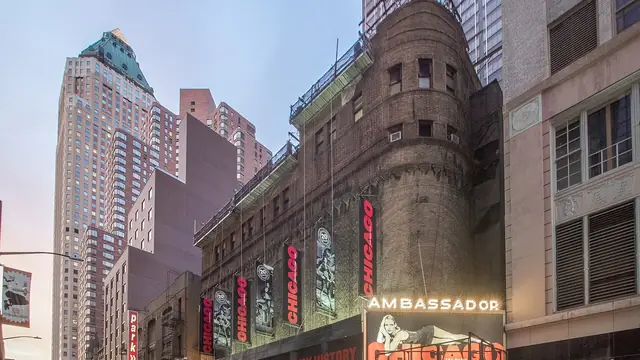
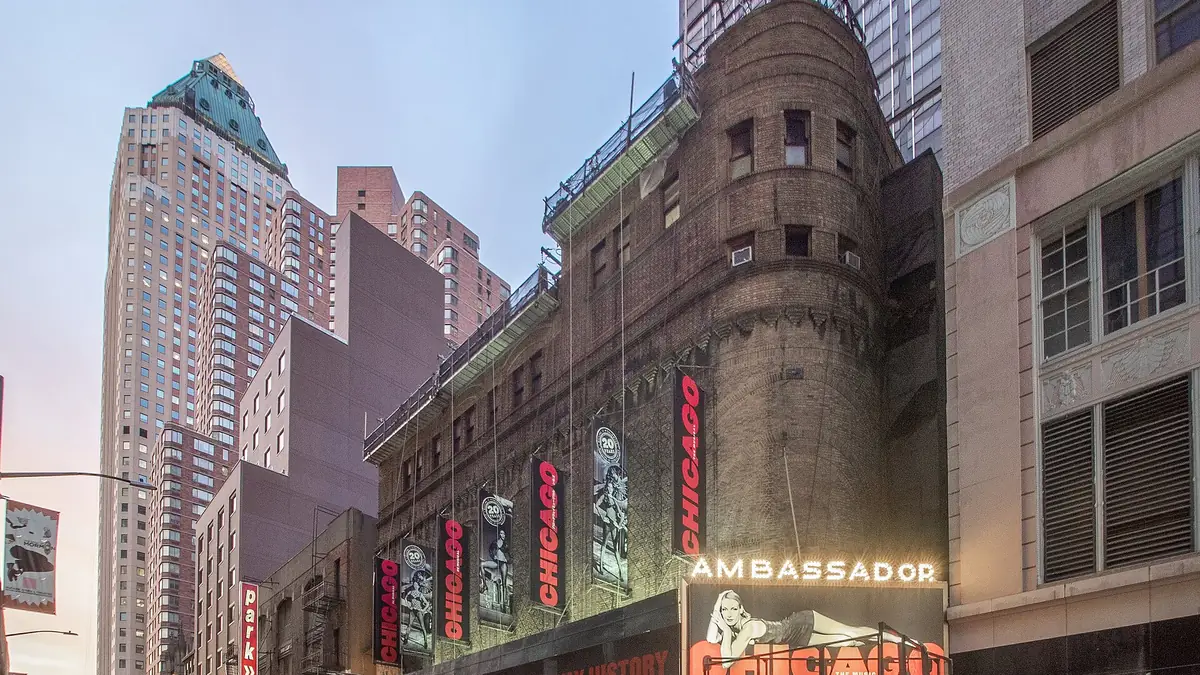
The Shubert Organization owns the house, at 219 West 49th Street between Broadway and Eighth Avenue. The Broadway revival of Chicago moved in on January 29, 2003, and as of 2026 it is the longest-running show still playing on Broadway, with more than 11,000 performances. No run lasts forever, so confirm current dates in the listings on this page.
Orchestra, mezzanine and boxes by the numbers
Shubert's chart counts 1,114 places: 573 in the orchestra, 264 in the front mezzanine, 250 in the rear mezzanine, 8 in boxes and 19 standing-room spots. Wikipedia cites a Broadway League total of 1,125 and notes that 41 of the orchestra seats sit in the pit area.
Orchestra
About half the house, on the ground floor, reached from the lobby without steps.
Front and rear mezzanine
One upper level divided into a forward block and a back block of similar size. Wikipedia calls it the balcony; Shubert tickets say mezzanine. Getting there means two flights, 38 steps in all.
Boxes
Eight seats beside the stage, with an angled view.
The proscenium (the arch framing the stage) measures roughly 45 feet across and 25 feet high. It is a moderate opening, which helps keep most seats feeling connected to the stage.
Seats that suit this production
Chicago is spare by design: a minimal set and Bob Fosse-style choreography where the line of a hip or a hat tells the story. You want a clean look at bodies in motion, not at scenery, and that changes the usual Broadway advice.
- Center orchestra, rows E to M: close enough for faces, far enough for the full width of the dance. The safest buy in the building.
- Front center mezzanine: the angle from above shows the patterns the choreography makes, which is why many repeat visitors pick it over the orchestra.
- Rear mezzanine, center: complete and farther away; good value if you stay near the middle.
Seats to skip or discount
- Extreme side seats: the diagonal plan curves these around toward the stage, and from the farthest ends the near edge of the stage can disappear.
- Rear orchestra: under the mezzanine overhang (the underside of the level above), where sound can feel muffled.
- Front rows: some people love the closeness; others find the upward angle tiring and lose the depth of the stage picture.
How demand behaves for a long runner
A show that has run for decades sells differently from a new hit. There is no opening-night spike and no closing rush, so prices stay steadier through the year. The pressure points are holiday weeks, Saturday nights and weeks when a celebrity guest is in the cast. Weeknights outside the holiday season usually offer the widest choice of center seats.
Center orchestra and front mezzanine set the top of the market; rear mezzanine and side seats sit at the bottom. Each Reserved Seat order is covered by a 100% guarantee.
Access and assistive services
If you need to avoid stairs, book the orchestra. The Shubert Organization says every part of that level is step-free, while the mezzanine is 38 steps up.
- Seven wheelchair spaces, all in the orchestra, each with a companion seat.
- Eleven aisle seats with folding armrests for transfers; the Theatre Development Fund guide puts six downstairs and five upstairs.
- The main entrance has two small steps, and the side entrance has none.
- A unisex ADA restroom sits beside the ticket lobby.
- Infrared listening devices, audio description and captioning are offered, and the GalaPro app adds captions.
Shubert Audience Services takes accessible bookings; contact details are on the Shubert Organization's Ambassador page. Bag and screening rules are set by the theater and can change, so check the current policy before you go.
Subway, bus and arrival timing
The closest option is the 1, C or E to 50th Street. Walk one block south to 49th, then turn east toward Broadway, as the Theatre Development Fund suggests. Times Square-42nd Street is a few more blocks but connects almost every line. On the surface, the M7, M20 and M104 run along the avenues and the M50 crosses town.
West 49th Street jams up in the half hour before curtain, and again when several nearby theaters let out at the same time. Plan to arrive about 30 minutes early, and after the show walk a block or two away before looking for a cab or rideshare.
From operetta to radio, film and Fosse
The Ambassador was part of a post-World War I building spree by the Shubert brothers, one of four houses they opened on 48th and 49th Streets. Its first night, February 11, 1921, brought the operetta The Rose Girl, and Blossom Time soon ran 516 performances. The plain gold-beige brick exterior reflects the economy of that era; the interior is finished in Adam-style detail.
The Shuberts let the building go in 1935. Over the next two decades it was a CBS broadcast studio, a movie theater and a DuMont Television Network studio before the family bought it back in 1956 and returned it to live shows. Godspell played here in 1976, Fosse's Dancin' from 1980 to 1982, and Bring in 'da Noise, Bring in 'da Funk for 1,130 performances. The city landmarked the interior in August 1985, though the exterior designation did not stand.
Chicago itself took a winding road here: it opened at the Richard Rodgers Theatre in November 1996 and spent time at the Shubert Theatre before the 2003 move. Broadway's March 12, 2020, shutdown paused it, and performances resumed on September 14, 2021.
Frequently asked questions
What are the best seats for Chicago at the Ambassador Theatre?
Center orchestra from about row E to row M, or the front center mezzanine. Both give a straight view of the choreography without the angle of the side seats.
Why are the side seats at the Ambassador Theatre a problem?
The auditorium is built diagonally across a square lot, so the outer seats curve around toward the stage. From the far ends, part of the near side of the stage can be cut off.
How many steps up is the Ambassador Theatre mezzanine?
Thirty-eight steps over two flights, with no elevator. All wheelchair locations are in the orchestra.
How long has Chicago played at the Ambassador Theatre?
Since January 29, 2003. As of 2026 it is the longest-running show currently on Broadway, with more than 11,000 performances.
What is the seating capacity of the Ambassador Theatre?
Shubert lists 1,114 places including 19 standing-room spots; the Broadway League figure is 1,125.
Which subway stop is closest to the Ambassador Theatre?
50th Street on the 1, C or E. Walk one block south to 49th Street and head east.