
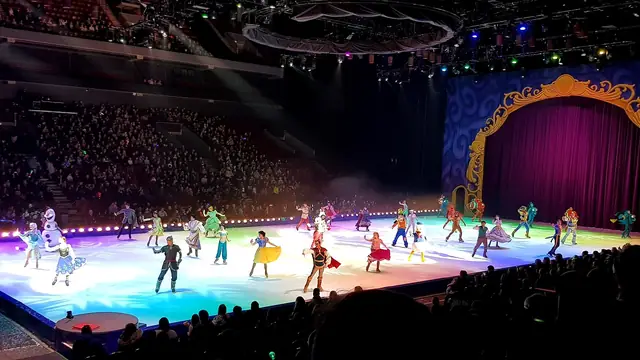





Your ice show seat in one paragraph
Choose a lower-bowl seat along one of the long sides of the rink, near center ice, roughly in the middle rows. From there you see the whole sheet of ice, the group formations click into shape, and you are still close enough to read the skaters' faces. Most of the choreography in a touring ice show is built as patterns meant to be seen from slightly above, which is why a seat a few rows up beats the very front.
The two kinds of show change the details. Character shows, led by Disney on Ice, cast figure skaters as film characters and are aimed at young children, so a close seat where a character might wave has real appeal. Skating showcases, led by Stars on Ice, put Olympic and world-level skaters on the ice with no characters, and the jumps and spins read best from a raised angle. Both play the indoor arenas that host hockey and basketball, and both tour, staying a day to a few days per city.
How the rink and stage end reshape the arena map
For a skating show, the arena floor becomes a full rink, much as it does for hockey, and the skaters use all of it. What changes is one end of the building.
- The stage end: the set, the skaters' entrance and usually a video screen occupy one end of the ice. Sections directly behind or beside it are often closed or sold with partial views.
- Rinkside: at many stops a few rows of chairs are placed on the floor at the edge of the ice and sold as premium seats.
- The lower bowl: the 100-level ring of seats closest to the floor, wrapped around the rink as for a hockey game.
- The upper bowl: the 200 or 300 level, depending on the building.
Always open the seat map for the specific event rather than the arena's hockey chart. The position of the set decides which sections are on sale and which ones look straight into the back of the scenery.
Seat-by-seat trade-offs for skating fans and families
- Center ice, lower bowl, mid rows: the safest pick for any ice show. Full rink, clear formations, good sight of expressions.
- Rinkside chairs: thrilling for small children and the likeliest spot for a character's wave. The cost is a low, flat angle that hides skaters on the far side and squashes the group patterns. For Stars on Ice, where height and rotation are the point, go higher.
- The end opposite the stage: a straight-on look at the set and every entrance, from farther away. Often a fair value.
- Corners near the stage end: usually the weakest seats in the building, since part of the action disappears behind the set.
- Upper bowl, center: the budget choice. Formations read well, but small children can lose track of tiny figures, so pack binoculars.
Rows close to the ice are noticeably cold, in spring as much as in winter. Bring a jacket or a blanket for every member of the group. Reserved Seat backs every order with a 100% guarantee.
Character tours: Disney on Ice
Feld Entertainment produces Disney on Ice under an agreement with Disney. Feld acquired the Ice Follies and Holiday on Ice in 1979, put Walt Disney's World on Ice on the road in 1981 and had five touring productions running by 1988. The show took the Disney on Ice name in late 1997.
Several productions travel at once, each with its own cast and lineup of characters. As of fall 2026, the show's site lists five titles, among them Find Your Hero, Magic in the Stars and Magic of Family, so the characters your child sees depend on which production is booked into your arena.
Because a production usually stays several days, you can often pick between weekday and weekend performances. Saturday and Sunday mornings and early afternoons suit toddlers and are the first to sell; weekday evenings are quieter. Running time, age guidance and the premium pre-show option are on the Disney on Ice page.
Olympians on tour: Stars on Ice
Figure skater Scott Hamilton and IMG executive Bob Kain founded Stars on Ice in 1986, and IMG still produces it. A Canadian tour was added in 1990, the show first played Madison Square Garden on February 19, 1993, and it has since toured the United States, Canada, Japan and China. Kristi Yamaguchi, Katarina Witt, Kurt Browning, Evan Lysacek and Nathan Chen are among its past headliners.
The tour runs each spring, once the competitive season ends. In 2026, the US leg played 26 cities between April 16 and May 31, featuring Ilia Malinin, Alysa Liu, Madison Chock and Evan Bates, Amber Glenn and Isabeau Levito; the Anaheim date was May 16 at Honda Center. A Canadian leg covered 13 cities from April 23 to May 16. As of fall 2026, the tour's site points ahead to 2027.
Casts change every season. In a Winter Olympic year such as 2026, the newest medalists lead the spring tour and pull extra demand, so expect stronger sales in those years.
Holiday dates and where the genre came from
The traveling ice show is an American creation. Ice Capades debuted in Hershey, Pennsylvania, in 1940 and toured for roughly five decades until it folded in 1997. Holiday on Ice started in Toledo, Ohio, in December 1942; today it is based in Bremen, Germany, under a subsidiary of CTS Eventim, and its tours stay in Europe.
In the United States, the winter holidays belong mainly to family shows. Disney on Ice dates that fall during school winter break draw the heaviest demand, and performances between Christmas and New Year's Day usually sell ahead of weekday shows earlier in December. Other seasonal family outings, including the Radio City Christmas Spectacular, are gathered on the Family-Friendly Shows page.
Show-day planning for families
- Check which production is coming. With several Disney on Ice titles touring, confirm the characters before promising them.
- Set a souvenir budget early. Character shows sell merchandise and snacks throughout the building.
- Read the arena's bag rules. Ice shows follow the building's own policy, and many arenas limit bag size. Check the venue's current policy before you go.
- Leave extra time. Parking and security move slower at family shows, especially with strollers.
- Expect effects. Disney on Ice uses strobe lighting, fog and confetti, which matters for children sensitive to light or noise.
Frequently asked questions
Are rinkside seats worth it for young children?
They can be, because characters skate right past and sometimes wave. The view is low, though, so skaters on the far side and the big group patterns are harder to see.
Which seats should I avoid at an ice show?
Corners and side sections next to the stage end, where the set blocks part of the rink. Check the event's own seat map, since sections near the set may be closed or limited view.
How do Disney on Ice and Stars on Ice differ?
Disney on Ice, produced by Feld Entertainment, casts skaters as Disney characters for young audiences. Stars on Ice, produced by IMG, is a skating showcase built around Olympic and world-level skaters with no characters.
What time of year does Stars on Ice tour?
Spring, after the competitive season. The 2026 US tour played 26 cities from April 16 to May 31, and the tour's site points to a 2027 tour.
Which Disney on Ice dates sell first?
Weekend morning and early afternoon shows, and performances during school winter break, especially between Christmas and New Year's Day. Weekday evenings tend to have more choice.
Is Ice Capades still touring?
No. Ice Capades opened in Hershey, Pennsylvania, in 1940 and shut down in 1997. Holiday on Ice still operates but is based in Germany and tours Europe.