
_-_Full_(48124330357).jpg)
Looking for section numbers and the best seats by level? See the Madison Square Garden Seating Chart.
Upcoming events at Madison Square Garden
Dates and live ticket listings appear here as soon as they are on sale. The guide below covers what to know before you buy.
Where to sit at the Garden, briefly
At Madison Square Garden, the seat that satisfies the most buyers is the front of a center-court or center-ice 200 section. You see plays develop, the scoreboard sits near eye level, and the price usually sits well below the lower bowl. Pay for the sideline 100s only if being close matters more to you than taking in the whole floor.
The arena seats 19,812 for New York Knicks basketball, 18,006 for New York Rangers hockey and up to about 22,000 for concerts. It is round, so think of it as a stack of rings: the 100s, the 200s, the Chase Bridges above and the Blue Seats tucked high on the sides.
The rings, from floor to rafters
100 Level
The lower bowl runs to about row 22. Do not assume row 1 is the front: premium floor-level rows sit ahead of some sections.
200 Level
The upper bowl starts at row 1 and climbs to roughly row 25. Most fans sit here, and it is where prices are usually most approachable.
Chase Bridges (300s)
Two walkways hung roughly 94 feet above the floor, added in the 2011 to 2013 renovation, each with two rows of seats looking almost straight down.
Blue Seats (400s)
A few short sections of about seven rows, perched high along the sides.
Different sellers give premium areas different marketing names, so trust the section number on the listing. Guides also disagree about which sideline holds each bench, so confirm that on the event map if it matters.
Seats to pick for Knicks, Rangers and shows
Knicks
Center-court 100s put you close enough to hear sneakers and the bench. For value, rows 1 to 8 of a center 200 section are hard to beat. Corner 100s are a fair compromise. The low rows of the baseline 100s are the weakest seats downstairs, because the basket stanchion sits in your view and the far end loses depth.
Rangers
Height helps more in hockey. Seats in row 10 or higher in the 100s, or the front of the 200s, show passing lanes and line changes. Low rows behind the glass feel exciting, but the boards hide the near side of the ice. End sections in the 200s are good value, since rushes coming straight at you are easy to read.
Concerts
With an end stage, the side 100s and side 200s nearest the stage give the best balance of closeness and angle. The floor may be general admission or reserved, depending on the tour, and it is flat, so shorter fans will watch over heads. When a show goes in the round, every side faces the stage and the 200s become even more attractive.
Seats with a catch
- Top rows of the 200s. A full view, but players look small, and anyone uneasy with heights should stay near the front of the section.
- Chase Bridge seats. Looking straight down is memorable once, but it flattens the game, and some second-row seats lose part of the center-hung scoreboard behind the roof structure.
- Back rows of the Blue Seats. Seating guides warn that the rear rows, around 5 to 7, can have obstructions.
- Behind the stage at a concert. These are sold as limited view for a reason; buy only if the listing describes what you will see.
Demand rises during Knicks playoff runs, for Rangers games against nearby rivals, on Saturday nights and over the holidays. Midweek games against less popular opponents are where resale prices tend to ease. Every Reserved Seat order is backed by a 100% guarantee.
Trains under the building
The Garden sits directly on top of Penn Station, so Amtrak, Long Island Rail Road and NJ Transit trains arrive under your feet. On the subway, take the A, C or E to the Eighth Avenue platforms or the 1, 2 or 3 to Seventh Avenue; both stations are called 34th Street–Penn Station. From New Jersey, PATH trains end at 33rd Street and Sixth Avenue, about two blocks east.
Driving is slow and costly. The arena has no garage of its own and directs drivers to reserve nearby garage space through SpotHero. After a sellout, rideshare pickups at the doors crawl, so walk a few blocks away from Seventh and Eighth Avenues before you request a car. Entrance maps are on the venue's website.
At the door (rules as of fall 2026)
The Garden's posted rules as of fall 2026 are below. They change, so check the venue FAQ before you go.
- Bags: no clear-bag requirement, but every bag must fit under your seat, and nothing larger than 22 by 14 by 9 inches gets in. All bags go through an x-ray.
- Coats: there is no bag or coat check, so in winter your coat sits with you.
- Tickets: digital, on your phone; load them before you arrive. Some artists hold phone-free shows with locked pouches, and those use printed tickets.
- Re-entry: none. All exits are final.
- Payment: cashless, with a machine that converts cash to a debit card.
- Kids: most events let children younger than 2 ride on a lap, but certain family shows ticket everyone over age 1.
- Smoking: banned, e-cigarettes included.
Use the entrance printed on your ticket rather than the closest door; it is assigned to your section and usually has a shorter line.
Four Gardens and two banner-raising tenants
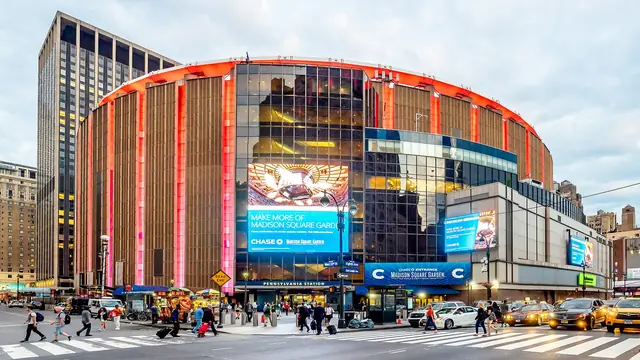
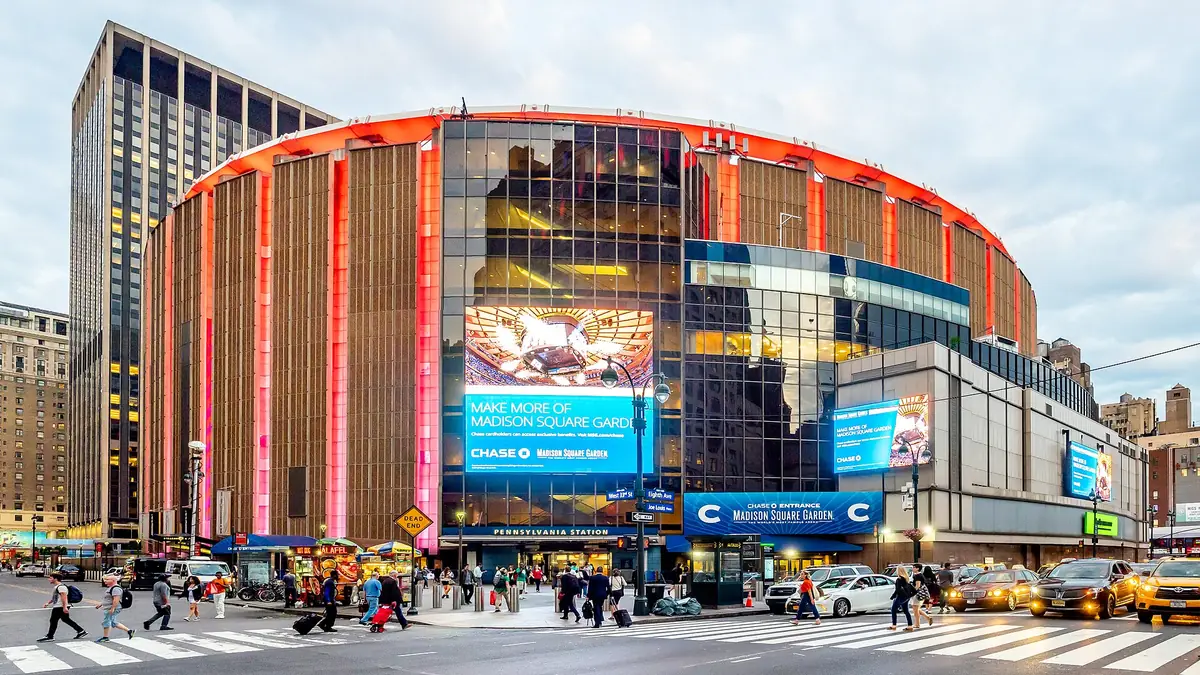
The name is older than the building. Gardens one through three stood from 1879, 1890 and 1925, each replaced in turn. The current one, the fourth, opened February 11, 1968, on the site of the original Pennsylvania Station, whose above-ground building was torn down to make room. Its roughly 1 billion dollar makeover came in three phases over consecutive off-seasons: seating closest to the floor first (2011), then the upper seats, suites and club (2012 to 2013), and finally the lobby, scoreboard and bridges (2013 to 2014).
Both tenants have deep roots here. The Rangers, one of the NHL's Original Six, arrived for their debut season in 1926 and have four Stanley Cups (1928, 1933, 1940, 1994). The Knicks date to 1946, when they helped found the league now called the NBA, and their 2026 championship was their first since 1973, following the 1970 title. St. John's men's basketball and the Big East men's tournament also play here, alongside boxing, family shows and major tours. Billy Joel's monthly residency ran from January 2014 to July 25, 2024, ending with his 150th show in the building. The city renewed the arena's operating permit for five years in 2023, leaving its future relationship with Penn Station an open question in New York City.
Frequently asked questions
Are 200-level seats at Madison Square Garden good?
The front rows of center 200 sections are often the best value in the arena, with a full view of the floor and the scoreboard near eye level. The top rows feel high.
Is row 1 the front row in the 100 level at MSG?
Not always. Premium floor-level rows sit in front of some 100-level sections, so row 1 may have rows ahead of it.
Are Chase Bridge seats worth it?
They offer an unusual straight-down view from about 94 feet up, which is fun once. For following the game, the 200 level is better, and some second-row bridge seats lose part of the scoreboard.
How many people does Madison Square Garden hold?
It seats 19,812 for basketball and 18,006 for hockey. Concerts can reach about 22,000, depending on the stage.
Do I need a clear bag for Madison Square Garden?
No, as of fall 2026. Bags must fit under your seat and be no larger than 22 by 14 by 9 inches, and all are x-rayed. Check the current rules before you go.
What is the fastest way to get to Madison Square Garden?
By train. Penn Station is directly below the arena, the 34th Street–Penn Station subway stops serve six lines, and PATH ends two blocks away.
Sources
- Wikipedia – Madison Square Garden
- Madison Square Garden – FAQs
- Madison Square Garden – Venue home
- Billy Joel – Final show of MSG residency announced
- Wikipedia – New York Rangers
- Wikipedia – New York Knicks
- ESPN – Knicks win the 2026 NBA Finals
- Wikipedia – 33rd Street station (PATH)
- From This Seat – Madison Square Garden seating chart breakdown
- Barry's Tickets – Knicks seating chart guide