
.jpg)
Looking for section numbers and the best seats by level? See the Barclays Center Seating Chart.
Upcoming events at Barclays Center
Dates and live ticket listings appear here as soon as they are on sale. The guide below covers what to know before you buy.
The quick seat verdict for Barclays Center
For a basketball game, the seats to want at Barclays Center are the center-court lower sections, 7 to 9 and 23 to 25. If those are out of reach, the corners of the lower bowl keep both baskets in view for less, and the first eight or so rows of the center 200-level sections deliver a clean, full-court look at a much lower premium. The building was shaped for basketball, so even upper seats feel closer than they would in a hockey-first arena.
Barclays Center opened on September 21, 2012, at the meeting of Atlantic and Flatbush Avenues in Brooklyn. The Brooklyn Nets (NBA) and the New York Liberty (WNBA) play their home games here, the NBA Draft is held here, and the calendar fills with concert tours, boxing and wrestling. Capacity is 17,732 for basketball and as many as roughly 20,000 for concerts.
Decoding sections 1–31, the 100s and the 200s
The numbering trips up first-time buyers because the main lower ring does not use triple digits. Here is how the building is organized, according to seating guides such as TicketIQ:
- Courtside and floor: seats right on the court, often marked with an F on charts.
- Lower bowl, sections 1 to 31: the primary lower ring, running up to about row 19. Sections 7 to 9 and 23 to 25 are at midcourt; sections 1, 15 to 17 and 31 are behind the baskets.
- The 100-numbered band: a thin strip of seats and premium boxes perched at the top of the lower bowl, only a few rows deep.
- 200 level, sections 201 to 231: the upper bowl. Midcourt sections (about 206 to 210 and 222 to 226) climb to around row 22; corner and end sections are shallower, at about 13 rows.
The practical rule: never assume a 100 means lower bowl here. A seat in section 8 is closer to the court than a seat in section 108. Seating guides put the Nets bench in front of section 7. Club and lounge names change with sponsors, so judge a premium listing by its section and row rather than its branding.
Basketball seats worth the money
- Midcourt lower bowl (7 to 9, 23 to 25): the premium view, and the most expensive non-courtside tickets in the building.
- Lower-bowl corners (such as 3 and 4, or 19 and 20): the smart compromise. The diagonal angle still shows both ends of the floor, and pricing usually drops a step.
- Front rows of the center 200s: the value play. Rows 1 to 8 in sections 206 to 210 and 222 to 226 see plays develop across the whole court.
- Low rows behind the baskets: fun for a dunk at your end, frustrating for everything else. The stanchion and the players along the near baseline hide much of the far court.
Demand runs highest for marquee Nets opponents, Liberty playoff games and NBA Draft night. Resale prices tend to rise in the last days before a sellout, so committing early to a specific section usually beats waiting.
Concerts, boxing, ice events and seats to question
End-stage concerts
Most tours set the stage at one baseline, which removes or limits the sections behind it. The lower side sections nearest the stage are the strongest reserved seats, and the center 200s on the sides work well because the bowl is compact. The floor puts you closest, but on a flat floor your view depends on the people in front of you.
Boxing and wrestling
A center ring turns every side into a front row. Any lower-bowl side is a good choice, and the 200 level gains value because the action never moves.
Listings to think twice about
- Behind-the-stage seats: worth buying only if the listing clearly says side or rear view and you accept that.
- Upper corners for hockey or ice shows: when the New York Islanders played here from 2015 to 2020, part of one end of the rink was hidden from sections 201 to 204 and 228 to 231, a side effect of the basketball-first design.
- The last rows of the corner 200s: the farthest seats from the floor. Fine for a casual night, disappointing for a big game.
Every Reserved Seat order is backed by a 100% guarantee.
Entry rules: small bags, phones and no re-entry
Barclays Center's bag rule is tighter than most. As of fall 2026, the arena's posted rules include the following; confirm the current version before you go.
- Size limit: no bag larger than 10 by 6 by 2 inches, which excludes most purses.
- Backpacks: not allowed, whatever the size.
- No-bag lanes: express entry for guests carrying nothing.
- Tickets: digital only. Screenshots and printouts do not work, and barcodes show up 24 to 72 hours before the event.
- Re-entry: not permitted for any event.
- Paying: concessions are cash-free; kiosks outside sections 7, 23 and 31 convert cash to a prepaid card.
Save the ticket to your phone's wallet before you leave so it loads instantly at the gate. The arena's A to Z guide has the full list.
Getting to Atlantic and Flatbush
Transit is the only sensible way in. The arena sits on top of the Atlantic Avenue–Barclays Center station, served by the 2, 3, 4, 5, B, D, N, Q, R and W trains, and the Long Island Rail Road terminates across the street at Atlantic Terminal. Buses including the B37, B41, B45, B63, B65, B67 and B103 stop nearby.
Driving is a bad bet. The arena has no parking lot of its own, a rarity among major American venues, and it describes nearby parking as very limited. If you have to drive, book a garage spot ahead of time. After the event, walk a few blocks away from the Atlantic and Flatbush intersection before calling a rideshare to escape the worst of the traffic.
Brooklyn's long road to an arena
The idea of a big-league venue at this corner is older than the arena. In the 1950s, a domed stadium for the Brooklyn Dodgers was proposed just to the north, on land now occupied by the Atlantic Terminal mall. The Dodgers left for Los Angeles in 1957 instead.
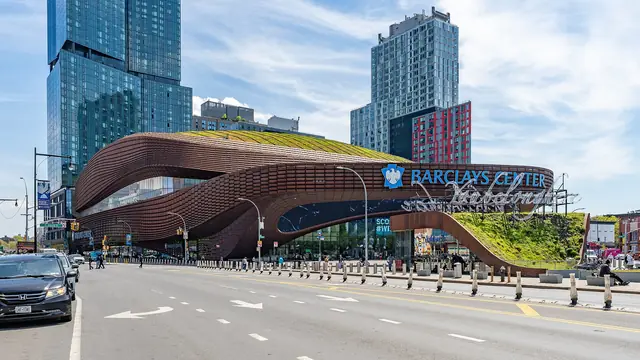
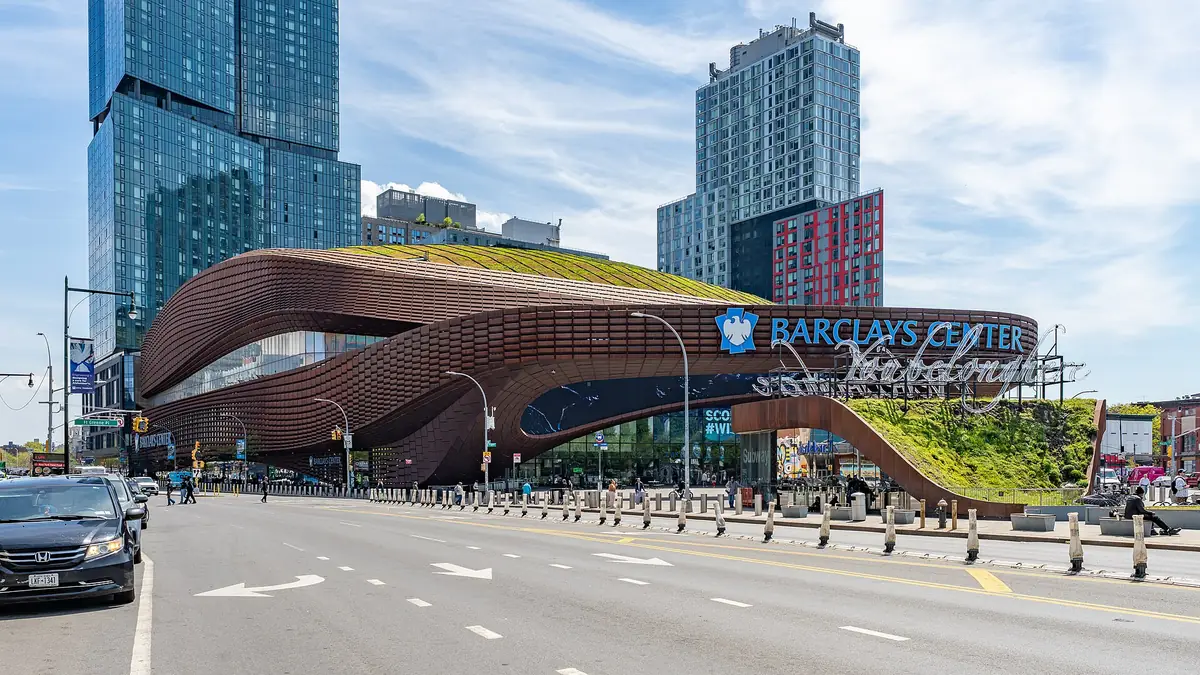
Developer Bruce Ratner's Forest City Ratner revived the plan in 2004 as the anchor of the Atlantic Yards project, today called Pacific Park, and bought the then-New Jersey Nets the same year to bring them across the river. Eminent domain fights, lawsuits and the recession pushed groundbreaking back to March 11, 2010. The building, wrapped in about 12,000 pre-weathered steel panels with a 117-by-56-foot oculus over the plaza, opened in 2012 with a run of Jay-Z concerts starting September 28. Its floor sits below street level, so people on the plaza can see the scoreboard through the glass.
Joseph Tsai took full control of the Nets and the arena in 2019. The Liberty arrived for the 2021 season and won their first WNBA championship on this floor in 2024, beating Minnesota 67–62 in Game 5.
Frequently asked questions
Is section 8 or section 108 closer to the court at Barclays Center?
Section 8 is closer. The main lower bowl is numbered 1 to 31, while the 100-numbered seats are a small band at the top of the lower bowl.
Where is the Nets bench at Barclays Center?
Seating guides place the Nets bench in front of section 7, one of the midcourt lower-bowl sections.
Can I bring a backpack to Barclays Center?
No. As of fall 2026, backpacks are banned at any size and other bags must be 10 by 6 by 2 inches or smaller. Check the arena's current policy before you go.
Which subway lines stop at Barclays Center?
The 2, 3, 4, 5, B, D, N, Q, R and W trains stop at Atlantic Avenue–Barclays Center, and the LIRR ends at Atlantic Terminal across the street.
How many seats does Barclays Center have?
It holds 17,732 for basketball, 15,795 for hockey, about 16,000 for boxing and up to about 20,000 for concerts.
Are screenshots of tickets accepted at Barclays Center?
No. As of fall 2026 entry is digital only, screenshots are not valid, and barcodes appear 24 to 72 hours before the event.