
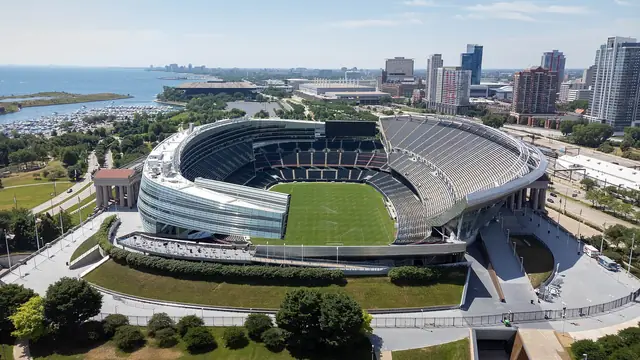
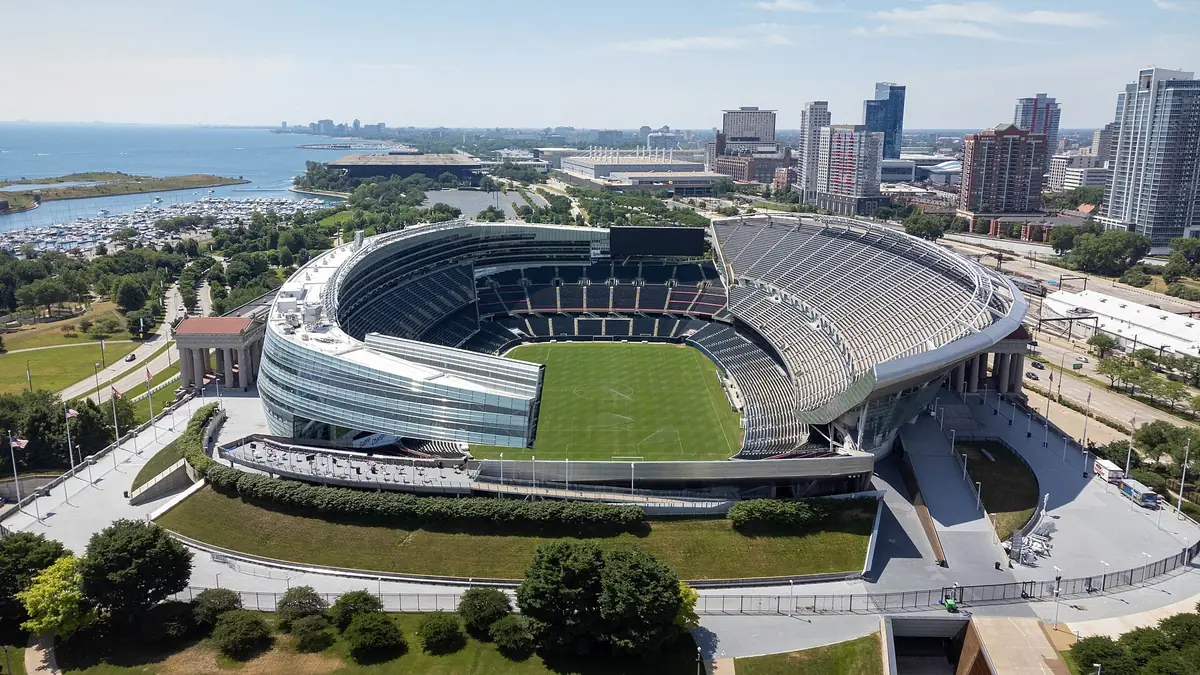

Upcoming events at Soldier Field
Dates and live ticket listings appear here as soon as they are on sale. The guide below covers what to know before you buy.
The Seat Call, Made Simple
For most Chicago Bears games, your best bet at Soldier Field is a lower-bowl seat inside the 10-yard lines, from roughly mid-section to the top of the 100 level. You sit high enough to see over the players and staff crowding the sideline, and close enough to feel the hits. In December, the east-side United Club is the comfort pick because the ticket includes an indoor lounge. On a budget, the 300 level along either sideline still gives you the whole field.
Size works in your favor. With 62,500 seats for football, only one NFL stadium is smaller than Soldier Field, so few seats are truly far from the action. What matters more is which side you choose, how high you sit and how exposed you are to wind off Lake Michigan.
East Side vs. West Side, Level by Level
The playing surface is oriented north–south, so one sideline faces east and the other faces west, and the two sides are built differently. Understanding that is the key to reading any Soldier Field map.
Around the whole bowl
- 100 level: the lower ring right on the field. Seat guides locate the home bench on the west side, around section 133.
East side (the club side)
- United Club, three levels: 202 through 216 and 301 through 317, with entry at Gates 6, 12 or 38 and a climate-controlled lounge.
- Sideline Club: the front row (row A) in 103–105 and 113–115.
- Touchdown Club: the first row (row 1) across 119–126.
West side (the grandstand side)
- Mezzanine: 200-level seating, including 128 and 136; the heated Miller Lite Midway sits behind 136 and 138.
- Media deck overhang: third-party guides place roughly sections 232–242 beneath it.
- 400 level: the upper grandstand, which climbs higher and steeper than anything else in the building.
The 300-numbered sections also wrap around the two end zones.
Matching Seats to Weather and Budget
- For the clearest football view: 100-level rows from the middle up, between the 10s. The front rows sit at bench height and lose much of the field behind the sideline crowd.
- For rain or snow cover: the west 200 level under the media deck overhang, around sections 232–242.
- For a frigid December afternoon: east-side club tickets, which let you warm up indoors before and during the game.
- For value: 300-level sidelines, you still see every yard, for far less than club pricing.
Sun, as a rule of thumb: during an afternoon game, the low sun hangs in the southwest. East-side fans squint into it, and the west grandstand casts shade over its own lower rows first.
The schedule: the Bears' regular season runs from September into early January, and the late-season home games bring cold and lake wind. Chicago Fire FC plays an MLS season from about late winter into fall, and summer brings stadium concerts, international soccer and rugby. Concert floor layouts change with each tour, so use the event map rather than a football chart.
Where You Will Regret Sitting
- The 400 level if heights bother you. It is steep, high and wide open to the wind.
- Low rows in the north and south end zones. From near field level, plays at the far end are hard to read.
- The patio above section 354 in winter. Lake views and high-top tables, plus a wind that rarely lets up.
- Front 100-level rows on the sideline. Close on paper, blocked in practice by everyone standing along the bench area.
Reserved Seat covers every resale order with a 100% guarantee.
Getting to the Museum Campus
Spaces near the stadium are scarce, and the Bears push fans toward transit. For 2026, you cannot buy parking at the gate for the lots hugging the stadium; a prepaid pass is required. They open four hours before kickoff and shut two hours postgame.
If you drive
- Prepaid, on the campus: Lexus North Garage, Waldron Deck, South Lot, East Museum Lot, Adler lot.
- Prepaid with a shuttle: McCormick Place Lot B, whose free shuttle drops on 18th Street just west of the Drive and runs until two hours postgame.
- Drive-up, no shuttle: McCormick Place's Lakeside Lot C, which may be tight during conventions.
- More drive-up spots: Northerly Island, Adler and Burnham Harbor.
The residential blocks between Roosevelt and Cermak, from Clark Street east to DuSable Lake Shore Drive, are off limits; parked cars get ticketed and towed.
If you ride
- CTA: the Roosevelt stop serves the Red, Orange and Green lines; walk east from there or transfer to the #146 bus.
- Metra: the closest stations are 18th Street and Museum Campus/11th Street, and the #128 express bus shuttles fans from downtown Metra terminals.
- From Indiana: the South Shore Line stops at McCormick Place.
- Rideshare: the designated zone is where Balbo meets Columbus.
Tailgating is allowed in three areas: surface lots on the campus, the Waldron Deck's top floor, and McCormick Place's B, D and E lots. Stay within one space and skip open flames; tailgating stops during the game and is not allowed after night games. Details are in the team's parking and transit page.
Clear Bags, Gates and Lounges (2026)
For the 2026 Bears season, the stadium follows the NFL clear-bag policy, meaning bags must be see-through plastic, vinyl or PVC. You may carry one of the following:
- a see-through bag no bigger than 12 x 6 x 12 inches (clear backpacks, belt bags and drawstring bags count);
- a gallon-size clear freezer bag; or
- a small non-clear clutch or purse, 4.5 x 6.5 inches at most.
Leave opaque backpacks, luggage, coolers and camera cases behind, along with diaper bags unless medically needed. Card-only rental lockers are available at the 18th Street turnaround and on the Field Museum's East Terrace.
- Gates: doors open 120 minutes ahead of kickoff, and everyone walks through metal detectors.
- Tickets: mobile only in the Chicago Bears app; screenshots will not scan.
- Money: the stadium is cash free.
- Leaving: no re-entry.
- Smoking: banned, vaping included, with no smoking areas.
- Accessibility: all gates are accessible; Gate 8 handles exchanges for wheelchair seating.
Concerts and soccer may use different rules, so check the Bears bag policy or your event's page before you go.
Inside: Levy handles food and drinks, with self-checkout stations and grab-and-go markets added in recent seasons. You may bring personal food if it fits the bag rules, and for Bears games a blanket can come in over your arm or inside a clear bag. Access to the Miller Lite Midway, on the west Mezzanine concourse, costs extra. Two hours before kickoff, both the United Club lounge and the free pregame party on the Field Museum Terrace open. One elevator is just inside Gate 6 at the southeast corner; another, behind section 128, goes up to the West Grandstand and Media Deck.
Background: A 1924 Stadium Rebuilt From the Inside
The stadium debuted as Municipal Grant Park Stadium on October 9, 1924, and was renamed on November 11, 1925, honoring American soldiers killed in World War I. No NFL stadium is older. Ownership sits with the Chicago Park District, and ASM Global manages it. The Bears arrived in 1971 after decades at Wrigley Field.
In 2002 and 2003, the interior was torn out and a new bowl rose inside the old walls, keeping the Doric colonnades on the east and west sides. Capacity dropped from 66,944 to 62,500, and the makeover cost the stadium its National Historic Landmark status in 2006, having held it since 1987. Six years later, in 2012, it earned LEED certification, a first for the league. Chicago Fire FC returned as a tenant in 2020.
- Soccer: five 1994 World Cup matches, matches in the 1999 Women's World Cup, and more than one Gold Cup final.
- Music: the Grateful Dead's final shows, July 8 and 9, 1995.
- A first: the first commercial cellphone call, made here on October 13, 1983.
The Bears' long-term future here is uncertain. In a June 5, 2026 announcement, the franchise said its board backed moving forward on a new stadium in Hammond, Indiana, though no specific site had been picked. Any move is likely years off, so follow current news before you assume anything about later seasons. For more events across Chicago, including the United Center, see the city guide.
Frequently asked questions
What are the best seats at Soldier Field for a Bears game?
A lower-bowl seat inside the 10-yard lines, from about mid-section up. The very front rows sit at bench height, so the sideline crowd blocks part of the field.
Which Soldier Field seats are covered?
The stadium is open air, but third-party guides place west 200-level sections around 232 to 242 under the media deck overhang. East-side United Club tickets include an indoor lounge.
Is the 400 level at Soldier Field a good idea?
Only if you are comfortable with heights. It is the steepest, highest section of the stadium and is very exposed to wind.
Do I need to prepay parking at Soldier Field?
Yes, for the lots next to the stadium as of the 2026 season. Without a prepaid pass, try Northerly Island, Adler, Burnham Harbor or McCormick Place Lot C.
Can I bring a clear backpack to Soldier Field?
Yes, as long as it measures 12 x 6 x 12 inches or less. For 2026 you may bring one clear bag, a gallon freezer bag or a small clutch; confirm the rules before you go.
Are the Bears leaving Soldier Field?
Not any time soon. In June 2026 the team said its board backed moving forward on a stadium in Hammond, Indiana, but no site had been chosen.