
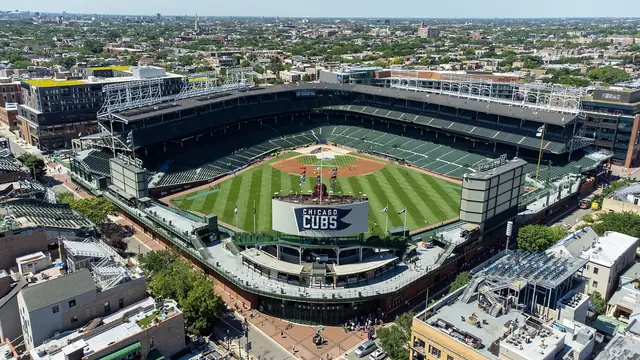
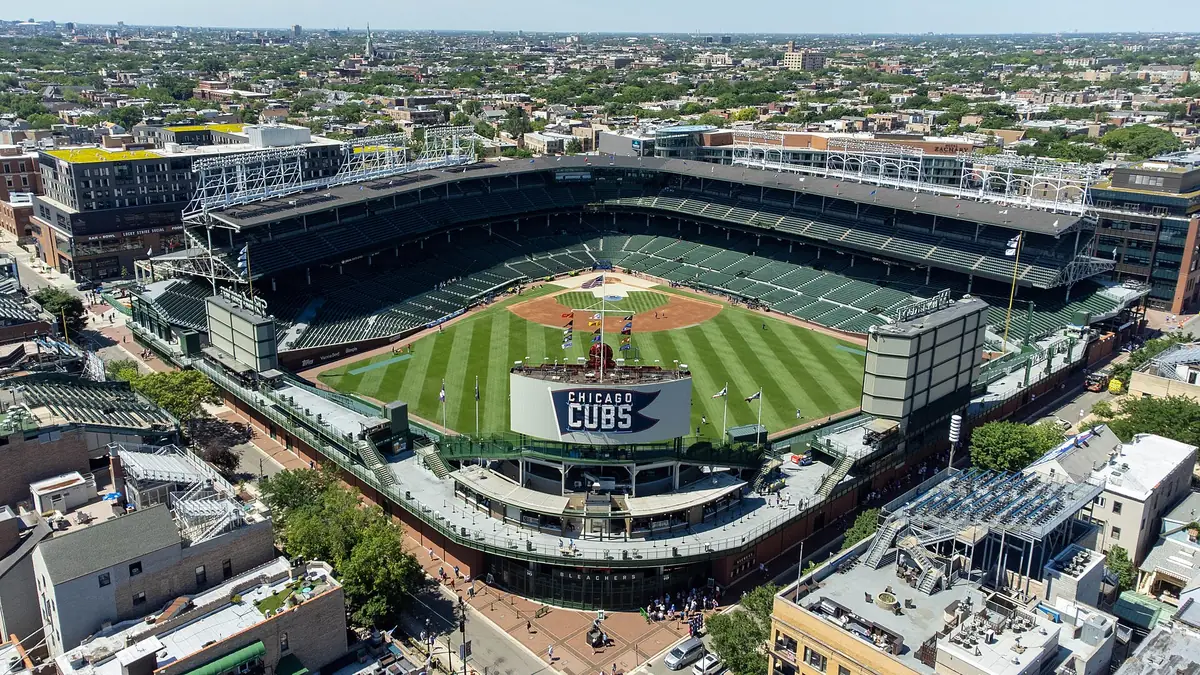

Looking for section numbers and the best seats by level? See the Wrigley Field Seating Chart.
Upcoming events at Wrigley Field
Dates and live ticket listings appear here as soon as they are on sale. The guide below covers what to know before you buy.
Choosing a Wrigley seat: the short version
For the closest view of a Chicago Cubs game, buy a 100-level field box between the bases. For value, go up to the upper box (the 300s) behind the plate, where the entire diamond, the ivy and the manual scoreboard are in view and no posts interrupt it. For a party, buy the bleachers and show up when the gates open. And if you buy in the 200-level terrace, check the row number before anything else, because steel poles hold up the upper deck.
Wrigley Field holds 41,649 and stands on Addison Street (number 1060 West) in the Lakeview neighborhood. It opened in 1914, making it the second-oldest active big-league park after Boston's Fenway Park (1912). Old, compact parks put fans close to the field, and they also bring posts, roof overhangs and a near-total lack of parking.
The six seating zones, field to rooftop
Since Opening Day 2019, every ticket uses a plain section, row and seat format. Working up from the grass:
- Club and box seats: the front rows around home plate.
- 100 level, field box: the lower bowl from one foul pole to the other.
- 200 level, terrace: behind the field boxes and beneath the upper deck. Its front rows (terrace box) sit ahead of the posts; everything behind them is sold as terrace reserved.
- 300 level, upper box: the lower rows of the upstairs deck, which carried 400s numbers until 2019. The team likens them to a second-deck seat at a newer ballpark.
- 400 level, upper reserved: a handful of rows behind the upper box, sheltered by the roof.
- 500 level, bleachers: outfield benches, first come, first served all regular season and assigned for playoff games.
Upper-deck sections end in L or R, as in 303L or 431R, marking which half of the park (toward left or toward right) you are in and which ramp gets you there. Note it before you arrive.
Poles, overhangs and seats to skip
- Terrace reserved rows near a pole: guides say the first post in a typical terrace section lands near row 6, though section 230's is back near row 17. Their advice: buy ahead of the posts, or aim for about rows 10–15, and confirm the exact row first.
- Back of the terrace: the deck above cuts off towering flies and the outfield screens.
- Field boxes deep in the corners: still close, but angled toward the outfield instead of the plate.
- Bleachers in a midsummer day game: no roof, and Wrigley schedules plenty of afternoon games.
Sun and shade, side by side
At day games, shadow creeps over the third-base seats as the innings pass. The terrace (covered by the upper deck) and upper reserved (covered by the roof) are shaded from start to finish. Expect the strongest sun on the first-base side, in the bleachers and in the right-field corner, where guides flag sections 29–32, 129–134 and 327–331.
Early and late in the season, flip the logic. On a spring or fall night, the lake wind can drop the temperature inside the park well below what your weather app says, so a sunny seat at a day game or a warm layer at night is worth planning for.
Seats to pick by priority
Closest to the game
Field boxes between first and third, near enough to hear players talking. Demand peaks from the plate out to the two dugouts.
Whole-field value
The upper box behind the plate. It is high enough to see every fielder and free of the poles that complicate the terrace.
Atmosphere
Bleacher fans make the most noise in the building. Because a regular-season ticket gets you in but not to a particular bench, the first row in left or right belongs to whoever gets there first.
Concerts
Stadium concerts have played here since 2005. Each tour builds its own layout, often closing or discounting seats around the stage, so trust the show's map over the baseball chart.
Rooftop seats
Private clubs atop the neighboring buildings past the outfield sell separate packages. A 2004 deal had those owners sharing revenue with the club, and the Ricketts family, which owns the Cubs, held ten of the buildings by the close of 2016. Expect a party setting and a distant view.
Getting to Clark and Addison, and getting in
Leave the car. The neighborhood has little parking, and the Cubs push fans toward transit. Ride the Red Line to Addison, which lets you off almost at the gate. Brown and Purple line trains and CTA buses work too, and Metra commuters can switch to the L downtown. The team lists Pace shuttles, on-site parking, rideshare zones and a bike valet on its Wrigley Field transportation page. After the last out, the Addison platform crowds up; walking a few blocks before calling a car usually helps.
As of the 2026 season, the limit is 16 by 16 by 8 inches for soft bags of any kind, including purses, drawstrings and soft coolers. Backpacks are not, clear ones included, and hard coolers are banned at any size. You may bring an empty plastic bottle. Touchless metal detectors let you keep your phone, wallet and keys in your pockets. Rules change, so check the Cubs security page before you go. Every Reserved Seat order is backed by a 100% guarantee.
On the west side, Gallagher Way, the plaza at Clark and Addison (called the Park at Wrigley when it debuted in 2017), hosts pregame activities, concerts and movie nights. Across Clark, the Hotel Zachary welcomed its first guests in April 2018.
Milestones of the Friendly Confines since 1914
Built as Weeghman Park, the ballpark first housed the Federal League's Chicago Whales. The Cubs arrived on April 20, 1916, and the name changed to Cubs Park in 1920 and to Wrigley Field in 1927.
- Bears era, 1921–1970: five NFL Championship Games were played here.
- Marquee, 1934: the sign over the main gate went up, gaining its red paint in 1960.
- Ivy and scoreboard, 1937: Bill Veeck's ivy and the manual scoreboard in center arrived together. Lose a ball in the vines and it is a ground-rule double.
- Lights, 1988: the final big-league park to add lights, with the first official night game on August 9 against the New York Mets.
- Winter Classics: the Blackhawks played outdoor NHL games here on New Year's Day 2009 and New Year's Eve 2024.
- 1060 Project, 2014–2019: a privately financed renovation delivered new bleachers, video boards and a restored exterior.
- Landmark status: a Chicago Landmark since 2004 and a National Historic Landmark since September 23, 2020.
Frequently asked questions
Which Wrigley Field seats have poles in the way?
Guides place the first post near row 6 in many 200-level terrace reserved sections, and near row 17 in section 230. Buy ahead of the posts or around rows 10–15.
Are the 300-level seats at Wrigley Field good?
The upper box behind the plate is among the park's best values: every fielder in view and nothing blocking it. The team compares those seats to a second-deck seat elsewhere.
Can you pick your seat in the Wrigley bleachers?
Only by arriving early. Throughout the regular season the bleachers are first come, first served; postseason bleacher tickets carry assigned seats.
Where is the shade at Wrigley Field?
The third-base side becomes shaded as an afternoon game goes on, and the 200-level terrace and 400-level upper reserved are covered. The right-field corner and bleachers get the most sun.
Are backpacks allowed at Wrigley Field?
No, clear ones included, as of 2026. Soft bags no bigger than 16 by 16 by 8 inches are fine; confirm the rule with the team before you go.
How old is Wrigley Field?
Wrigley opened April 23, 1914, and Boston's Fenway Park, from 1912, is the only older park still used by a big-league team.