
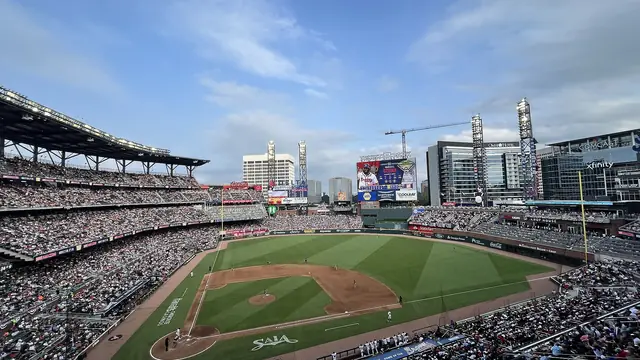
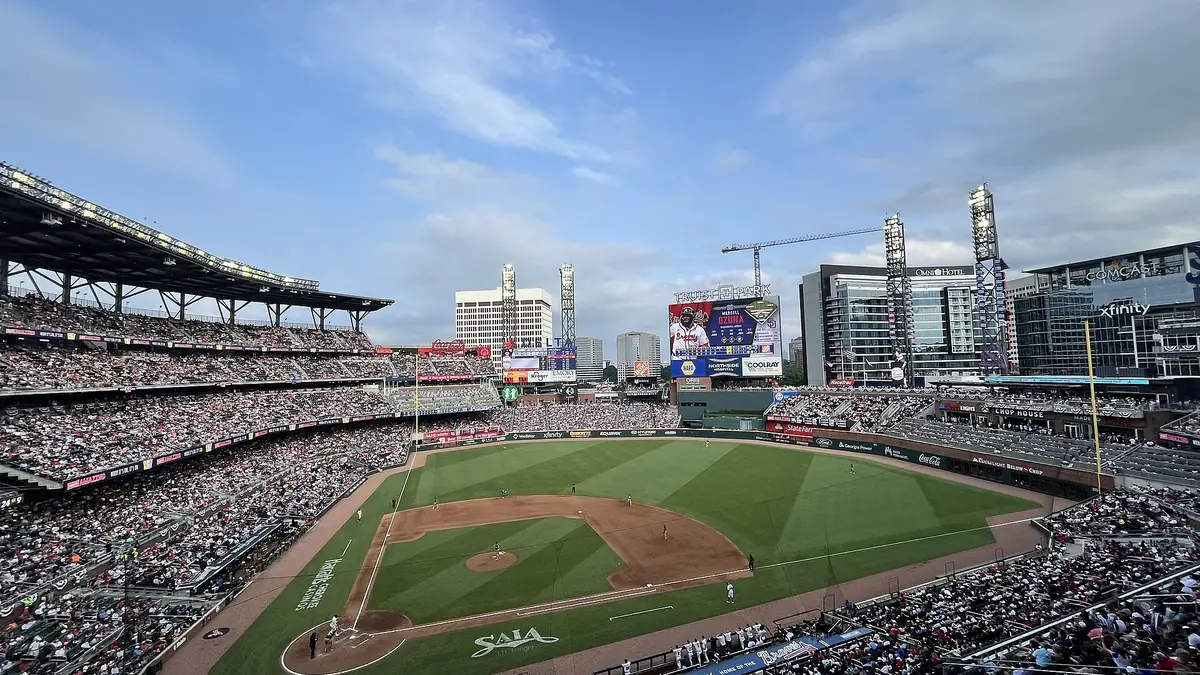

Upcoming events at Truist Park
Dates and live ticket listings appear here as soon as they are on sale. The guide below covers what to know before you buy.
The Truist Park seat decision, simplified
Start with the sun. For a summer day game, buy on the first-base side, which falls into shade sooner, and in the lower bowl go to row 10 or higher, where the deck above usually covers you. For the classic view, sit in the 100 level between the dugouts. For the most field per ticket, look at the 200-level Terrace between the bases (roughly 216–218) or the 300-level Vista above the infield (roughly 325–327), which seating guides single out.
Truist Park, home of the Atlanta Braves since 2017, seats 41,108. The park stands in suburban Cobb County, in the unincorporated Cumberland area roughly 10 miles from downtown Atlanta to the northwest, and no train line reaches the gate, so plan the trip as carefully as the seat.
Four levels, from Field to Grandstand
The ballpark is set into a slope, so most fans come in at a middle concourse and walk down. The decks above are cantilevered (they project out over the seats below), and the team says its highest, deepest seat sits 21 feet closer than the matching seat at Turner Field, the Braves' former park.
- Field (100s): the closest ring, wrapping both foul lines. Infield sections carry the lowest numbers, the dugout sections fall roughly between the teens and the mid-30s, and outfield sections reach the 140s and 150s.
- Terrace (200s): the middle tier, which includes the club seats between first and third.
- Vista (300s): the upper tier, where infield seats show every corner of the field at a lower price point.
- Grandstand (400s): the highest seats, largely shaded by the canopy.
Two independent guides agree that the home team uses the first-base dugout. One of them maps sections 16–21 behind the Braves, sections 31–35 behind the visiting club across the diamond, the visiting bullpen by 144–145 and the Braves' pen by 152–153.
Each gate is named for the part of the park it serves, and each is tied to a section number: 111 for right field, 120 for first base, 131 for third base, 141 for left field and about 160 for the Chop House. Walk in at the matching gate and you skip a long concourse loop.
Finding shade in a Georgia summer
A canopy about 90 feet wide arcs in a horseshoe along the roofline and covers roughly 60 percent of the seats. That still leaves plenty of exposed seating, and the sun pattern is consistent across guides:
- First-base side: shaded earlier in the afternoon. Combined with the home dugout, it is the strongest side for day games.
- Lower bowl, row 10 and up: generally covered by the tier overhead.
- Terrace and Vista: you typically need rows near the back to be covered.
- Third-base side, low rows: sun for most of a summer afternoon.
Night games change the calculus. Once the sun drops, proximity matters more than cover, and low third-base rows become a fine choice.
Seats to pick for different groups
Serious fans
Field-level seats from dugout to dugout, preferably behind the Braves on the first-base side. Safety netting extends 149 feet along the first-base line and 145 feet along the third-base line, which means front rows near the dugouts look through mesh; sit a few rows higher and it fades from view.
Value hunters
The Terrace and Vista infield picks named above. The vertical design keeps these closer than similar seats at older parks.
Groups and families
If your group wants to wander, head to right field. The Chop House, a restaurant with seating spread over several levels, and the rooftop club nearby reward socializing over pitch-by-pitch attention, and outfield seats keep everyone close to those spaces.
Truist Park seats to pass on
- Coca-Cola Corner: a 300-level perch out in left field, far from the plate and, per seating guides, without shade for day games.
- Deep right-field corner: the Chop House building blocks part of the view from certain seats.
- Low third-base rows at a summer day game: nine innings of direct sun.
Demand follows a predictable pattern. Weekends, fireworks or giveaway promotions and division rivals sell first, while weeknight games early and late in the season are the simplest to buy.
Driving, decks and the bus option
Driving is the default here. Over 11,000 spaces are owned or leased by the club, and the 2-mile radius holds roughly 30,000. For 2026, LAZ Parking runs Braves parking, passes are sold ahead at braves.com/parking, and same-day parking on site takes credit cards only. The lots and decks are color-coded (Red, Orange, Green, Purple, Silver, plus the Delta Deck), several have EV chargers, and there is no re-entry.
For a weekend game, buy a pass in advance. Roads around the ballpark clog early, and a close-in deck saves more time on the walk out than on the drive in.
- MARTA: catch the 12 bus at Midtown Station, ride to the Cumberland transfer point, and switch to the free Circulator shuttle.
- CobbLinc Route 10: serving Marietta and MARTA's Arts Center station, with no service on Sundays.
- Accessible shuttles: leave Lot N29 beginning two and a half hours ahead of first pitch and keep running for an hour postgame.
Confirm routes and parking on the Braves A–Z guide before you go.
Bag rule, food and gate times
Expect one of baseball's stricter policies. As of the 2026 season, Truist Park does not allow bags, with these exceptions: medical bags no bigger than the equipment requires, diaper and breast-pump bags, ADA-required bags, and a clutch or clear bag with one compartment measuring 5 by 9 inches or less. If you arrive with something else, paid lockers operate by the Orange and Truist Tower decks. Rules can change by season and for concerts; confirm the latest version before you go.
- Food from home: allowed if it fits in a transparent one-gallon bag; each ticket may also bring in a single sealed plastic bottle of water.
- Gates: they open 120 minutes ahead of most games and 80 minutes ahead of weekday afternoon games, sometimes earlier on giveaway dates.
- Cash: the park is cashless, with kiosks that convert cash to a card by sections 118 and 133 on the lower concourse.
- Re-entry: once you leave, your ticket is done unless a supervisor clears an emergency exception.
Reserved Seat backs every order with a 100% guarantee.
From Turner Field to The Battery
Word that the Braves would leave Turner Field broke in late 2013, giving the public about two weeks before county commissioners first voted on it; final approval of the agreement and financing followed in May 2014 amid organized opposition. Construction began on September 16, 2014. Its original name was SunTrust Park, and its first regular-season game, on April 14, 2017, was a 5–2 Braves win over San Diego. It took the Truist name on January 14, 2020, after SunTrust merged with BB&T to form Truist Financial. The ballpark cost about 622 million dollars; with The Battery Atlanta, the surrounding district of restaurants, bars and offices, the project topped 1.1 billion.
Three games of the 2021 World Series (3 through 5) were played here on the way to a Braves title, and the All-Star Game followed on July 15, 2025. Concert headliners have included Billy Joel, Metallica and Lady Gaga, and college football has been played here too. Behind home plate, the Monument Garden centers on a statue of Hank Aaron's 715th home run, hit April 8, 1974, backed by a wall of 755 bats representing his career total. Bobby Cox, Warren Spahn and Phil Niekro have statues of their own around the concourses. Arrive early for The Battery, which opens before the gates and is a good place to let traffic clear afterward.
Frequently asked questions
What are the best shaded seats at Truist Park?
First-base side seats in the lower bowl at row 10 or higher, which sit under the deck above and get afternoon shade earlier. The 400-level Grandstand is mostly under the canopy.
Which Truist Park sections are the best value?
Guides recommend the 200-level Terrace between the bases, roughly 216–218, and the 300-level Vista above the infield, roughly 325–327.
Can you bring a bag into Truist Park?
Mostly no, as of 2026. Exceptions cover medical, diaper, breast-pump and ADA bags and one-compartment clutches or clear bags no larger than 5 by 9 inches. Confirm the rule before you go.
Is there a train to Truist Park?
No rail line reaches it. Ride MARTA's 12 bus from Midtown Station to the Cumberland transfer point and take the free Circulator, or use CobbLinc Route 10 on any day but Sunday.
How many fans does Truist Park hold?
The listed capacity is 41,108, and roughly three in five seats sit under the canopy.
Can you bring food into Truist Park?
Yes. As of 2026, food fits in a transparent one-gallon bag, and each ticket may bring one sealed plastic water bottle.