
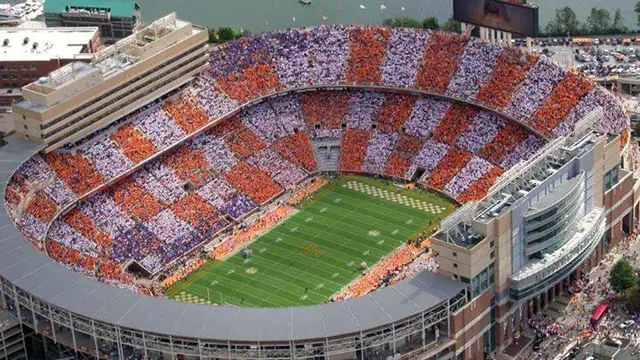
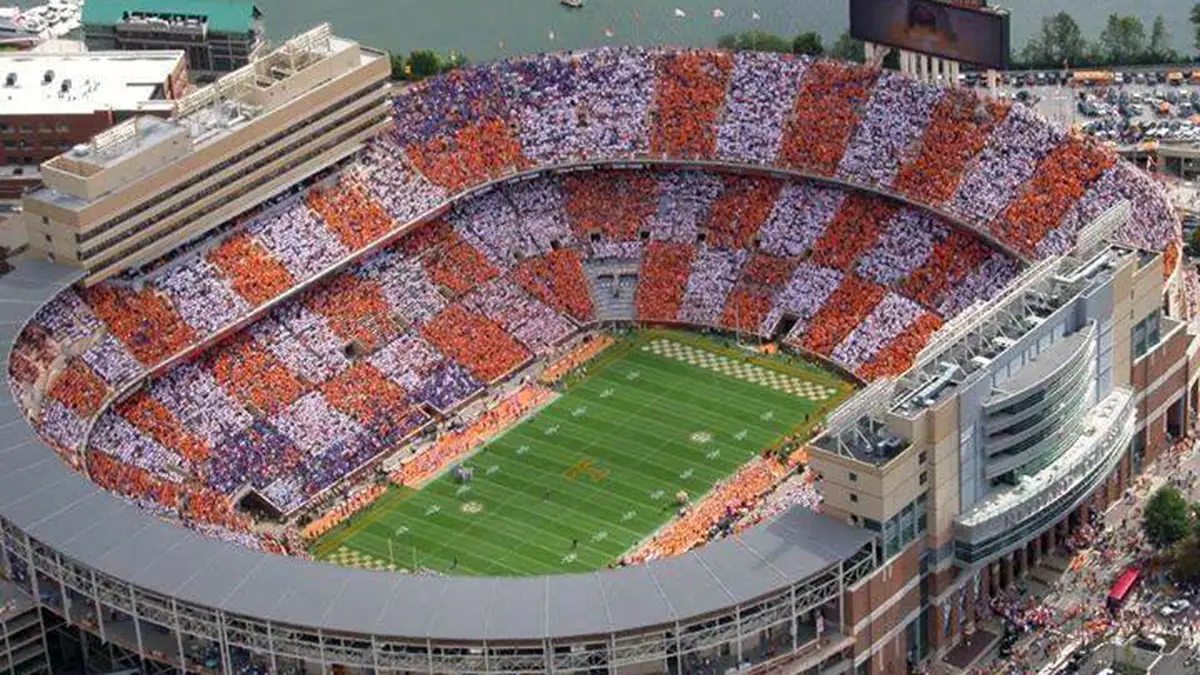

Upcoming events at Neyland Stadium
Dates and live ticket listings appear here as soon as they are on sale. The guide below covers what to know before you buy.
Buy the letter, not just the game
The best seat at Neyland Stadium for most Tennessee fans is a lower sideline seat in the middle rows, roughly the mid-30s to the high 50s in a section like B. That range clears the crowd on the bench, shows the full field and, near the top of it, puts you under the deck above, out of the September sun. The worst value for a Vols fan is the uncovered south-end corner, where the videoboard sits behind you and visiting fans fill the rows.
Knoxville's campus bowl belongs to the University of Tennessee and hosts the Tennessee Volunteers, with 101,915 seats since 2022. Its sections go by letters instead of the three-digit level numbers most newer stadiums use, so reading a listing takes a little practice.
- Best overall: lower sideline, middle rows.
- Best for heat: upper rows of a lower sideline section, under cover.
- Budget route: high rows and corners, with a long climb.
- Avoid as a Vols fan: the south-end visitor blocks.
Sun, cover and the rows that stay cool
Tennessee's early-season home games kick off in real heat, and the bowl is open to the sky. Cover comes only from the deck that overhangs the back of some lower sideline sections. In section B, for example, rows 52 and higher sit under that overhang.
The covered rows are not free of compromise. The overhang clips the top of the picture, so a high punt can vanish for a moment, and you are farther from the field than in the middle rows. For an afternoon game in early September, most fans gladly make that trade. For a night game or a cool November afternoon, the open middle rows win.
The front rows of a sideline section are the opposite problem: you are close, yet so low that the sideline crowd of players and coaches hides some of the near half of the field.
Visitor blocks and the south end
Road fans are concentrated at the stadium's south end. Rows 16 to 33 of GG, a corner section there, are reserved for the visiting crowd. GG sits fully exposed to the sun, and the main video screen is aimed at the north stands, so from the south side you will not see it.
- Cheering for the road team: those rows put you with your own people.
- Cheering for Tennessee: a south-corner ticket can seat you among the opposition, in the sun, with no scoreboard in view.
Also worth knowing: the visitors' bench is directly in front of section B, which places the Vols' bench on the other sideline. If you want to look at the Vols' sideline rather than over it, choose a section on the far side.
Decoding letters, gates and concourses
Seat guides and seating charts show three naming families:
- One letter (K, X or B, for example) marks a large lower-bowl section. On the sidelines these climb past row 60 and hold as many as 30 or so seats per row. Take B: rows 1 through 28, a cross-aisle, and rows 30 through 64 above it, with tunnels at 30 and 64.
- Two matching letters (GG, XX, FF) show up in other parts of the bowl, the south corners among them.
- Letter-and-number names, such as Z11 or ZZ12, in other parts of the stadium.
Only some sections have been mapped in detail by independent guides, so confirm the side, end and tier on your listing's seat map before buying. If you can, take an aisle seat at a tunnel row (30 or 64 in B) and skip the shuffle past a dozen knees.
Entry follows the stadium's 26 numbered gates, which run clockwise. For the North Concourse, use Gates 21 through 24; for the South, Gates 9 through 12; for the West, Gates 9, 14, 20 or 21. Elevators for fans with disabilities sit at Gates 4, 21 and 26.
Which games cost the most to get into
The home slate runs on Saturdays from the end of August or early September through November, and demand tracks the opponent. Southeastern Conference rivals such as Alabama, Florida and Georgia pull the largest crowds. Florida's visit on September 18, 2004, set the attendance mark of 109,061, a number the current, smaller bowl cannot match. Early nonconference games are typically the easiest way in.
Concerts here are rare. The Jacksons stopped on their Victory Tour in 1984, and Kenny Chesney played a 2003 stadium date. Each Reserved Seat order is backed by a 100% guarantee.
Campus parking, KAT buses and the Vol Walk
Neyland's street address is 1235 Phillip Fulmer Way, on campus and a short distance from downtown. Gameday spaces are spread over a long list of university lots and decks; Circle Park, World's Fair Park, the Ag Campus, the 11th Street and Locust Street garages and garages G10, G16 and G17 are a few of them. Donors and season ticket holders hold permits for most of the close spaces, so a one-game buyer should expect to park farther out or ride the bus.
- Buses: Knoxville Area Transit (KAT) adds gameday service.
- Accessible parking: available on arrival, without reservations, at the UT Institute of Agriculture (2450 E.J. Chapman Drive), where a no-cost shuttle starts running three hours before kickoff. When it fills, the overflow is the Knoxville Civic Coliseum, where the accessible shuttle charges a fee.
- Tailgating: fine in the campus zones marked for it, from pregame through the postgame. Overnight tailgating is not, and badly parked cars get towed.
Get there early for the Vol Walk. With 145 minutes to go before kickoff, players gather at Circle Park's Torchbearer statue, head down Peyton Manning Pass, turn onto Phillip Fulmer Way and disappear into Gate 21-A. Lots and shuttles shift from year to year, so check the Tennessee Athletics gameday page.
Clear bags, the perimeter and gate times
As of the 2026 season, Neyland uses a clear-bag policy (bags must be see-through). Your options: a single transparent plastic bag of 12 by 6 by 12 inches or less, or a gallon-size clear zip-top bag, and either one can be paired with a palm-size clutch (4.5 by 6.5 inches maximum).
- Left at the gate: any backpack or opaque bag, plus strollers, coolers, umbrellas, food from outside, selfie sticks, video cameras and noisemakers of any kind.
- Let through: a single sealed bottle of water straight from the store, and a seat cushion as long as it has no pockets or arms.
- Timing: four hours ahead of kickoff, an outer security ring with walk-through magnetometers goes live, and coolers stop there. Gates open two and a half hours before kickoff.
- Tickets and payment: mobile tickets, which cannot be transferred after a scan, and card-only concessions and merchandise.
- Re-entry and smoking: no re-entry, and lighting up (vapes count) is grounds for losing your ticket.
Inside, nursing parents can use a room on Concourse 2 by section Z11, medical staff cover four first-aid stations, and anything you leave behind is held at the Gate 21 elevators until the following Monday. Policies get revised frequently; read the athletics department's latest version before gameday.
Shields-Watkins Field through the years
When it debuted in 1921, the place held roughly 3,200 people; the turf beneath them was named Shields-Watkins Field then and still is. In 1962 the stadium was renamed for Robert Neyland, Tennessee's longtime coach and athletic director. Sixteen building projects pushed the count up: past 46,000 after World War II, beyond 64,000 in the late 1960s, over 91,000 by 1980 and to a high of 104,037 in 2000. Later renovations brought it back to 101,915.
Artificial turf covered the field for a quarter century, 1968 through 1993, until natural grass came back in 1994; crews have laid fresh Bermuda sod annually since 2007. Nonfootball moments include President Richard Nixon's 1970 appearance at a Billy Graham crusade, and the NFL held preseason games here into 1995. Tennessee has won better than three of every four games played here. For postseason trips, see the Music City Bowl and Liberty Bowl pages and the Nashville city guide.
Frequently asked questions
Which rows are covered at Neyland Stadium?
Only the upper rows of some lower sideline sections sit under the deck above. In section B, rows 52 and higher are covered; the rest of the bowl is open to the sun.
How many fans does Neyland Stadium hold?
Capacity is 101,915, a figure in place since 2022. The largest crowd, 109,061, watched Florida in 2004, when the bowl was bigger.
Which side is Tennessee's bench on?
The visiting team's bench sits in front of section B; Tennessee uses the sideline across from it. Confirm your section's side on the listing's seat map.
Can I bring a cooler to tailgate and then walk in?
You can tailgate with one in designated campus areas, but coolers cannot pass the security perimeter that opens four hours before kickoff.
What time does the Vol Walk start?
Roughly two hours and 25 minutes ahead of kickoff; it ends at Gate 21-A. Gates open two and a half hours before kickoff.
What bag can I carry into Neyland Stadium?
As of 2026, a single clear bag (12 by 6 by 12 inches maximum) or a gallon zip-top bag, with an optional small clutch. Confirm the current rules first.
Sources
- Wikipedia – Neyland Stadium
- Tennessee Athletics – Football Gameday Information
- Tennessee Athletics – Gameday Central and Clear Bag Policy
- RateYourSeats – Neyland Stadium Section B (orientation)
- RateYourSeats – Neyland Stadium Section GG (orientation)
- SeatGeek – Neyland Stadium seating chart (section naming)