
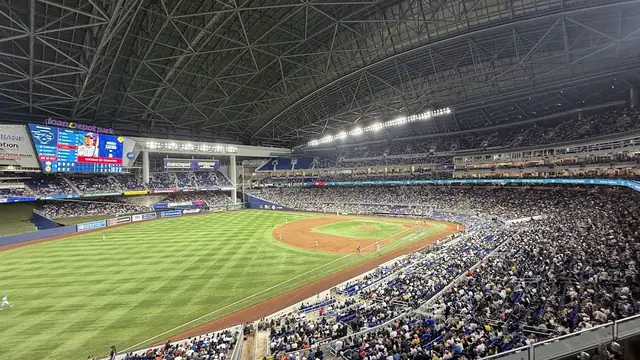
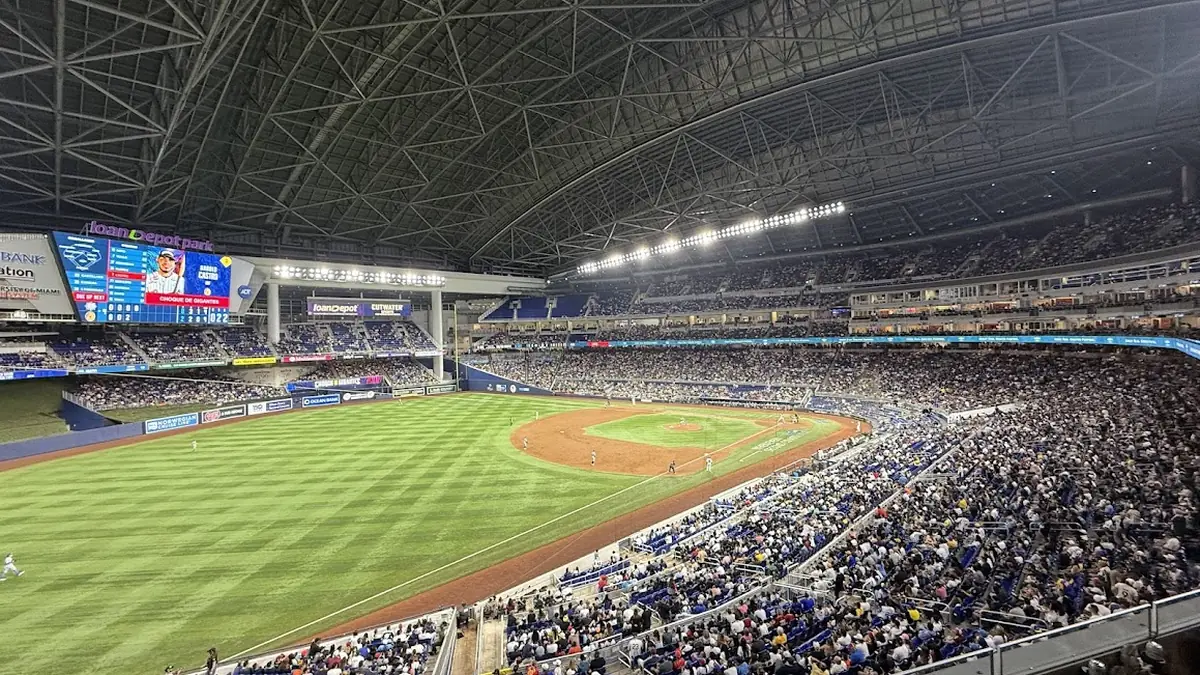

Looking for section numbers and the best seats by level? See the LoanDepot Park Seating Chart.
Upcoming events at LoanDepot Park
Dates and live ticket listings appear here as soon as they are on sale. The guide below covers what to know before you buy.
Where to sit, fast
For a Miami Marlins game at LoanDepot Park, the best balance of view and cost is a field-level seat between the dugouts, roughly rows 10 to 25, where you read every pitch without the backstop netting dominating your view. On a budget, take the lower Vista level between the bases, rows A through J. For noise and home run chances, sit in the Bullpen Zone or on the Home Run Porch in right field.
Unlike most ballparks, shade is rarely the deciding factor. The retractable roof stays closed for many summer games to keep out heat and storms, so the bowl is air-conditioned and every section is out of the sun.
Decoding the section numbers
The number on your ticket tells you the tier.
- FL1 to about FL16: premium seats closest to home plate, including the Dugout Clubs on each baseline with cushioned seats, a private entrance and in-seat service.
- 1 to 40: the main field level, foul pole to foul pole. Low numbers are near home plate, and they rise toward the corners.
- 134 to 141: the Home Run Porch, a second tier of outfield seats from right toward center.
- 201 to 228: the Legends level, a short ring between the bases. Legends Platinum seats are fully padded with a private concourse, and the Hall of Fame Club is behind home plate here.
- 302 to 327: the Vista level, or upper deck. Rows A to J sit below a walkway; rows WC and 1 to 16 sit above it.
Listings sometimes use the team's price tiers instead: Clubhouse Box (the first nine rows above the dugouts), Home Plate Box, Base Reserved, Baseline Reserved, Vista Box and Bullpen Zone. If you see a tier name rather than a number, match it to the map at checkout.
Seats worth paying for
Between the dugouts
Field-level rows 10 to 25 in the middle sections are the sweet spot. The first few rows behind the plate carry the highest prices and look through protective netting; moving back a handful of rows costs less and gives nearly the same view.
Lower Vista
Rows A to J of the upper deck between the bases look over the entire field and out through the glass wall in left. These are usually the least expensive seats in the building, and the view is honest. Above the walkway the deck gets steeper and farther away, but you still see straight down both lines.
Right field action
The Bullpen Zone sits beside the visitors' bullpen. The Home Run Porch gets more home run balls than anywhere else because the right field line is short. Fans who like to wander often settle on the standing-room rail in left field.
Seats to avoid, and how the field plays
- Field-level corners near the foul poles. These seats face center field, so you twist toward home plate on every pitch.
- The top of the Vista corners. The farthest seats in the ballpark, and the outfield corner below drops out of sight.
- The lowest outfield rows. In places they sit below the top of the wall, which hides balls on the warning track.
The dimensions explain where the action lands. Published distances are 344 feet down the left field line, 386 to left-center, 400 to center (pulled in from 407 before 2019), 387 to right-center (also changed in 2019) and 335 down the right field line, with 47 feet from home plate to the backstop. Wall heights run from about 6 to 16 feet after a 2016 redo. The short right side sends balls toward the Porch and Bullpen Zone, while the deep alleys keep many drives out of the lower left field seats. Grass covered the field from 2012 to 2019; since 2020 it has been Shaw Sports B1K artificial turf, which speeds up balls in the gaps.
Demand rises for weekends, giveaway nights and visits from rivals that travel well, such as the Mets and Braves. Midweek games in April, May and September draw the lightest crowds.
Roof, glass wall and game-day status
The movable steel roof spans 5.27 acres. It opens in about 14.5 minutes and closes in 7 to 8. The team makes the call for each game, and in a Miami summer that usually means closed; spring and fall dates see it open more often. Call the roof-status line at (305) 480-1300 a couple of hours before first pitch if it matters to you.
In left field, six retractable glass panels form a wall roughly 240 feet wide and 60 feet tall. Open, they let in a breeze; closed, they still frame the downtown skyline. In 2012 the ballpark became the first retractable-roof stadium to earn LEED Gold certification.
Garages, buses and rideshare
About 5,600 spaces are spread across four garages on the north and south sides and six surface lots. The garages are color-coded by the part of the field they face, so match the color to your seats:
- Blue: home plate.
- Yellow: first base (the one people mean by the "first base garage").
- Red: third base.
- Green: center field.
As of the latest season guide, you can prepay online, and the garages read license plates, so you pay at scanners or lobby stations instead of a gate. Prepaying is the surest way to get your preferred garage on a busy night.
Miami-Dade Transit buses 6, 7, 11, 12, 17, 21 and 51 serve the area. Game-day shuttles and trolleys have been reported from the Culmer Metrorail station and downtown, and Brightline has offered a free round-trip shuttle with its Home Runner tickets, but confirm the current schedule. Rideshare pickup is in East Lot 1, 1380 NW 6th Street. The Marlins ballpark guide lists current options.
Bags, gates and background
As of the current season guide, bags must be clear plastic, vinyl or PVC and no larger than 16 by 16 by 8 inches. Clutches under about 6 by 8 inches and medical or infant bags are exceptions. You can bring one single-serving food item in a clear bag and one sealed water bottle of 20 ounces or less. Gates usually open 90 minutes before first pitch, earlier for premium ticket holders, and tickets are mobile through the MLB Ballpark app. Smoking and vaping are banned, and re-entry is not allowed except to visit the team store. Check the current policy before you go. A Reserved Seat order comes with a 100% guarantee.
The ballpark opened for the 2012 season as Marlins Park and became loanDepot park (the brand's own lowercase styling) on March 31, 2021. It holds 37,442 with standing room, or 36,742 in fixed seats, and a 2017 World Baseball Classic game drew the record 37,446. It sits in Little Havana on the site of the Miami Orange Bowl, which stood from 1937 until 2008; Orange Bowl mosaic panels and seats remain on the grounds. Beyond roughly 81 home dates from late March or early April through September, it has hosted World Baseball Classic pool play in 2013 and 2017, the 2023 Classic final, the 2017 MLB All-Star Game, the Miami Beach Bowl from 2014 to 2016 and the NHL Winter Classic on January 2, 2026. Inside, the Bullpen Bar and Grill replaced the Clevelander pool bar (2012 to 2019), and the Red Grooms home run sculpture moved from center field to the outdoor plaza in 2018.
Frequently asked questions
Do I need to worry about sun at LoanDepot Park?
Usually not. The retractable roof is often closed in summer, which keeps the seating bowl shaded and air-conditioned. It opens more often in spring and fall.
Where is the best value seat at LoanDepot Park?
The lower Vista level between the bases, rows A through J, usually costs the least while still showing the whole field and the glass wall in left.
Where do home runs land at LoanDepot Park?
The short 335-foot right field line feeds the Home Run Porch and the Bullpen Zone, which catch more home runs than any other area.
Which garage should I use at LoanDepot Park?
Match the color to your seats: blue for home plate, yellow for first base, red for third base and green for center field.
How many fans does LoanDepot Park hold?
It holds 37,442 with standing room and 36,742 in fixed seats. The record is 37,446, set at the 2017 World Baseball Classic.