Upcoming New Orleans Jazz Fest dates
Dates and live ticket listings appear here as soon as they are on sale. The guide below covers what to know before you buy.
Pick your day first, then your spot
The New Orleans Jazz & Heritage Festival, called Jazz Fest by nearly everyone, is sold mainly as single-day tickets, and there are no assigned seats. That puts two decisions in your hands: which day to buy, and where on the Fair Grounds Race Course you will plant yourself once inside. The festival runs over two Thursday-to-Sunday weekends. For 2027 it has announced April 22 to 25 and April 29 to May 2, with gates at 11 a.m., music until 7 p.m. and last entry at 6:30 p.m.
Organizers balance the talent between the two weekends on purpose, so neither one is better on paper. Your day choice really comes down to the daily grid, known locally as "the cubes," which usually appears about a month before opening day. That release is when most serious buyers commit. If you cannot wait, Thursdays tend to be the calmer days, because they fall on a workday.
General admission and the VIP ladder
A general admission ticket gets you onto the grounds for one day, free to roam among every stage. Above it sit three VIP packages, named Krewe of Jazz Fest, Grand Marshal and Big Chief. What each includes is revised annually, so compare this year's versions directly. One perk matters more than the rest: a VIP package is the only way to pre-buy parking at the Fair Grounds, and the streets around the track are restricted.
Tickets go on sale once the lineup is announced, and in October 2026 the 2027 sale had not opened yet.
How resale demand behaves
- Big-headliner days, especially Saturdays, attract the most visitors from out of town.
- The cubes concentrate demand on specific days once the who-plays-when is public.
- VIP tiers hold value on both weekends, since buyers pay for parking, shade and access rather than one act.
Reserved Seat backs every order with a 100% guarantee.
Field stages, tents and the Grandstand
Most of the infield is open to the sun, with only a few scattered trees, and that one fact should shape your whole day.
- The big field stages, the Shell Gentilly Stage among them, are where the headliners play and the crowds pack in. If you want a good view of a closing set, settle in hours ahead with a chair or blanket, and aim for a spot with a clear line to the video screens rather than pushing forward late.
- The tent stages put a roof over your head and give sets an intimate, sit-down atmosphere. They suit jazz, gospel and traditional sets, and they make the best place to spend the hottest part of the afternoon.
- The Grandstand building is the official cool-down spot, with AC, chilled water and exhibits indoors.
A good rhythm for a first visit: tents in early and mid afternoon, a field stage as the sun drops, then a headliner from a spot you claimed earlier.
The rules for saving space
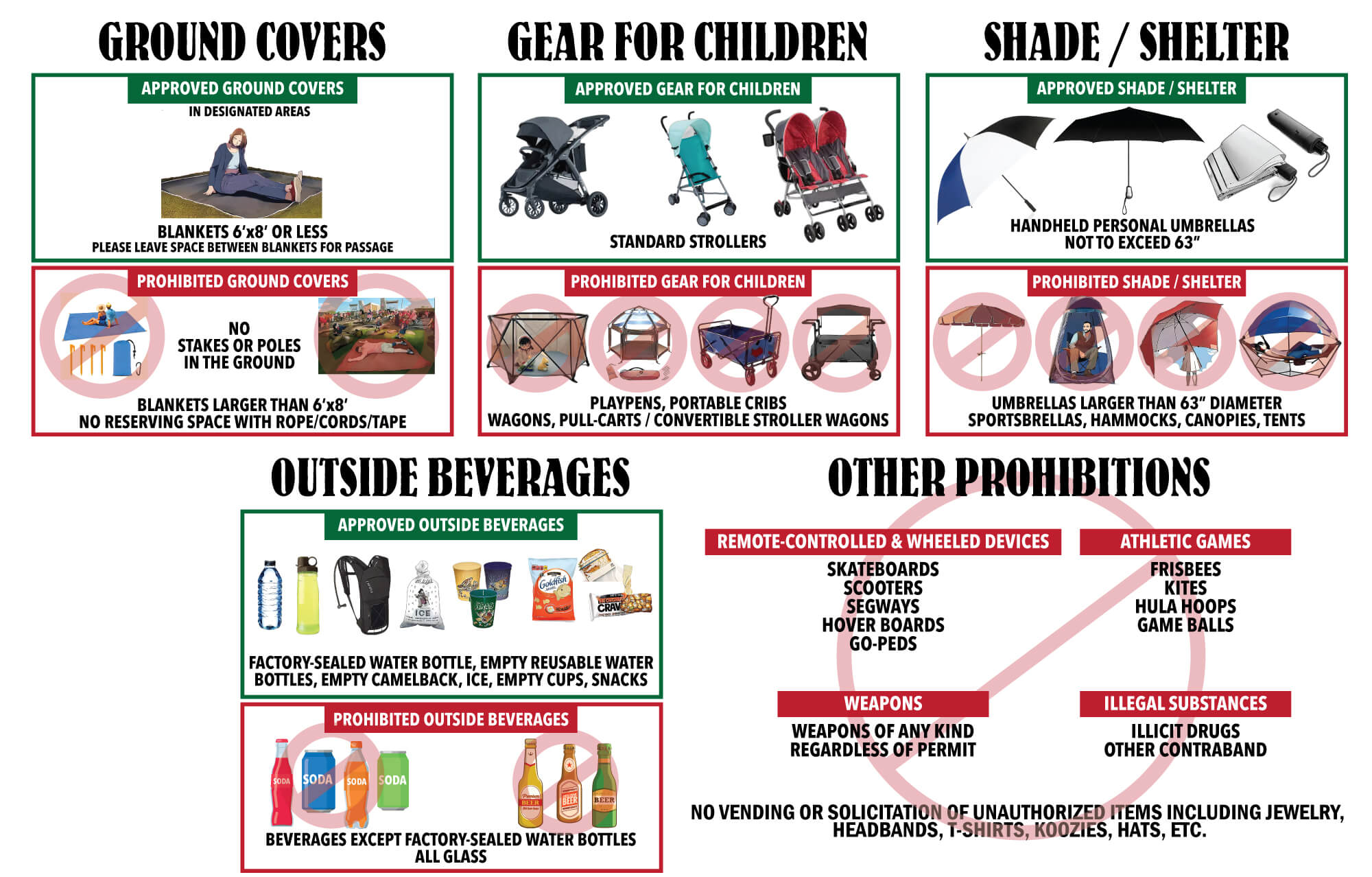
The 2026 guidelines capped blankets at 6 by 8 feet and limited them to marked zones. Nothing may be driven into the ground, and fencing off territory with tape, cord or rope is not permitted. Leave walkways between blankets so people can pass.
Louisiana on every stage and every plate
Jazz is only one part of the bill. Expect zydeco, Cajun, gospel, blues and R&B; Latin, Afro-Caribbean and folk; rock, rap, bluegrass and country, with both traditional and modern jazz woven through. Roughly 85 to 90 percent of the bands are active Louisiana musicians, by the festival's count. National names close the biggest stages each afternoon. The depth underneath them, from brass bands and Mardi Gras Indian groups to gospel choirs and zydeco bands, is what sets Jazz Fest apart from the big touring festivals. Organizers estimate about 400,000 visitors annually.
Food is a reason to go on its own. Generic fair fare is barred under an old rule against "carnival food," every vendor has to live in Louisiana full time, and there are more than 200 dishes, from crawfish dishes and po' boys to vegetarian plates. Craft shoppers can browse three markets (Louisiana Marketplace, Contemporary Crafts and Congo Square African Marketplace), and the Native American Village and Louisiana Folklife Village round out the cultural areas.
Shuttle, bike or taxi to Gentilly
The track is on Gentilly Boulevard (number 1751), a short 10-minute trip from the French Quarter, in a residential neighborhood where traffic is restricted during the festival. Sort out transportation before anything else.
- Jazz Fest Express: the festival calls it the only shuttle that loads and unloads inside the gates. Buses run on all eight days, starting around 10:30 in the morning and finishing around 7:30 in the evening. Pickup points: the Hyatt Regency (Loyola Avenue), the Sheraton (Canal Street), the Natchez riverboat dock in the Quarter, and a Wisner Boulevard lot in City Park that includes parking.
- Driving: only VIP package holders park on the grounds, along with a limited set of accessible spaces sold at the Horseman's Gate. Street parking nearby is for residents, and RVs and charter buses have nowhere to park.
- Rideshare: the city bars pickups and drop-offs inside a perimeter around the track, so plan on a walk.
- Bikes and walking: cyclists lock up for free by the Sauvage Street and Gentilly Boulevard entrances, and walkers can enter at those two plus Trafalgar Street.
- Taxis: cabs wait at Esplanade Avenue and Mystery Street, and beside Stallings Playground on Gentilly.
Rooms go fast. The festival urges booking as early as you can, and many regulars reserve the fall before.
Chairs, coolers and the 2026 packing rules
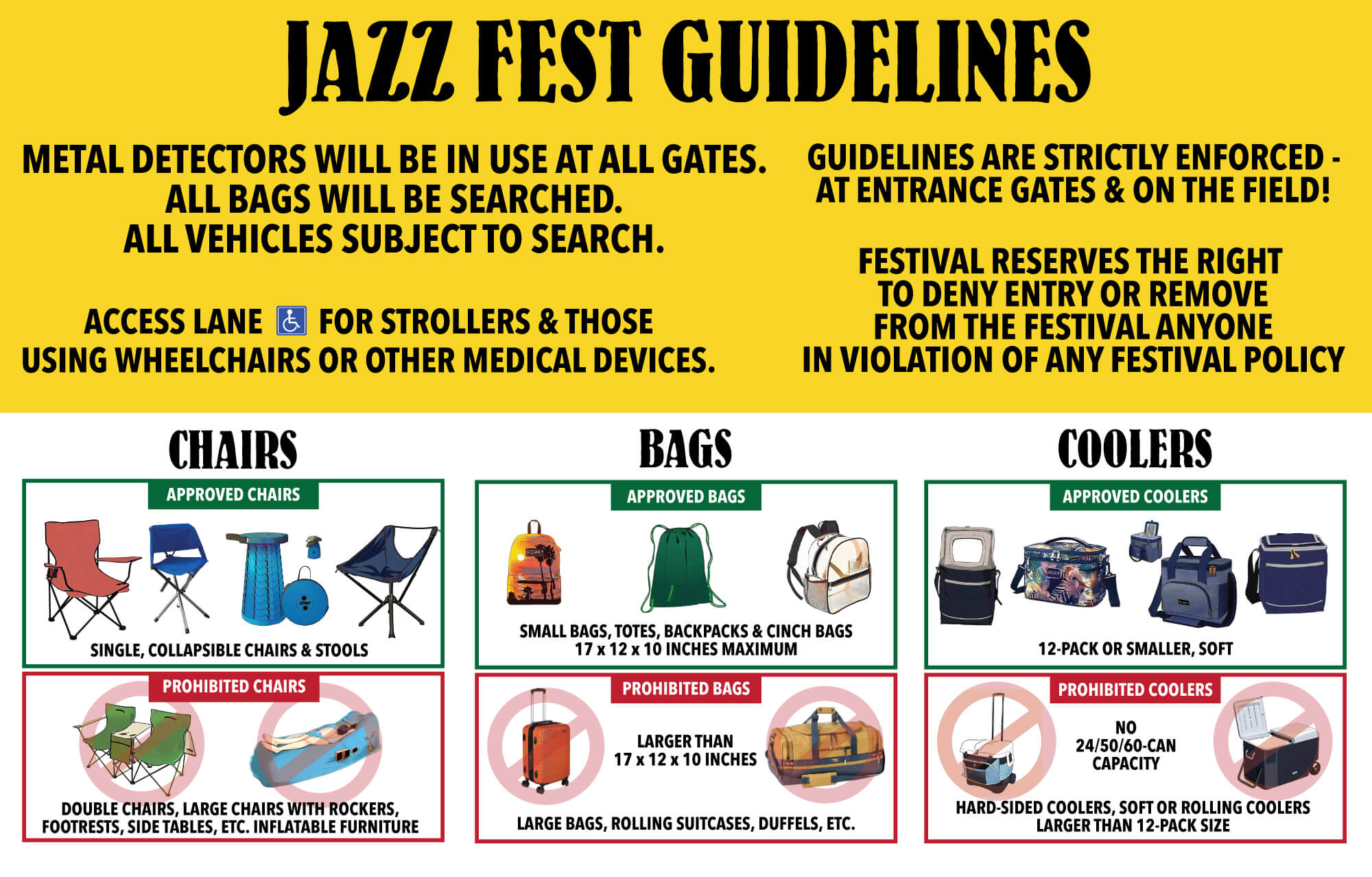
These rules come from the 2026 guidelines; confirm the current list on the Jazz Fest FAQ.
- Screening: metal detectors at every gate and a search of every bag.
- Bags: backpacks, totes, cinch sacks and other small bags are fine if they stay within 17 x 12 x 10 inches. Duffels and wheeled luggage are refused.
- Seating: one collapsible chair or stool per person. Double chairs, rockers, footrests and inflatables are out.
- Coolers: soft-sided, 12-pack size or smaller. Hard or wheeled coolers are not allowed.
- Drinks and snacks: snacks are welcome, as are ice, empty cups, an empty hydration pack, empty refillable bottles and a single sealed water. Glass and any other outside beverage stay home.
- Shade: a handheld umbrella (63 inches maximum) is the only portable shade allowed; hammocks, sportsbrellas, tents and canopies are banned.
- Kids: regular strollers yes, wagons and pull-carts no.
The grounds are cashless, so bring a card or phone wallet. Dress for sun: light clothing, a wide hat, sunglasses, sunscreen and shoes made for walking.
Fifty-plus years at the racetrack
George Wein, who had already created the Newport Jazz and Newport Folk festivals, launched Jazz Fest in 1970; Allison Miner and Quint Davis were part of the founding group. The debut drew roughly 350 people to a park where Congo Square once stood, the place enslaved Africans used on Sundays as a market and a gathering ground for music and dance. By 1972 it had moved to the racetrack infield. It expanded to a pair of weekends for 1976 through 1978, stretched to three for its tenth year in 1979, and then settled into the two-weekend format.
The Fair Grounds date to 1837, and the track is billed as the oldest active horse racing site in the country. A nonprofit foundation stages the festival and puts the proceeds into community grants, a music school and the radio station WWOZ 90.7 FM. Across seven days in 2017, roughly 425,000 people came through the gates. The pandemic canceled 2020 and 2021, and the festival returned in 2022.
- Longtime regulars: Dr. John, the Radiators, Ellis Marsalis and the Neville Brothers.
- Legends on the grounds: James Brown, Tina Turner, Ray Charles and Fats Domino.
- Big closers: by 2010, acts such as Christina Aguilera, Foo Fighters and the Eagles; in 2026 the billing led with Kings of Leon, Rod Stewart, Stevie Nicks and the Eagles.
Frequently asked questions
When do Jazz Fest daily schedules come out?
Roughly four weeks ahead of opening day. The grid is nicknamed the cubes, and many buyers hold off on choosing a day until it appears.
Where is the best place to watch a Jazz Fest headliner?
Arrive hours early at the field stage and choose a spot with a clear view of the video screens. Trying to work your way forward in the final hour rarely pays off.
Can I save space with a blanket at Jazz Fest?
Yes, within limits. The 2026 rules permit a blanket of 6 by 8 feet or less in marked areas, without stakes and without roping or taping off ground.
How do I park at Jazz Fest?
On-site parking is sold only with VIP packages, plus limited disability spaces. Most fans take the Jazz Fest Express shuttle, which parks at a City Park lot and drops off inside the gates.
Is Jazz Fest at night?
No. Music wraps at 7 p.m. after an 11 a.m. start, leaving evenings open for club shows around the city.
Does Jazz Fest take cash?
No. All booths are cashless and accept cards and mobile payments.