

.jpg)
Upcoming Detroit Red Wings dates
Dates and live ticket listings appear here as soon as they are on sale. The guide below covers what to know before you buy.
Red Wings seats: the short version
The strongest seats for a Detroit Red Wings game are the sideline sections at center ice: 121–123 behind the benches and 108–110 across the ice. Both carry club access. If you want that view without paying for the club, buy the neighboring 100 Level sideline sections at row 10 or higher, where the glass and the benches no longer get in the way.
- For Detroit goals up close: the end the Red Wings attack in the first and third periods.
- For a broadcast-style look down on the play: the gondola.
- For value upstairs: the front rows of the 200 Level, the Mezzanine.
- To avoid: the back rows of Mezzanine sections that sit under the gondola overhang.
The home schedule starts in October and ends in mid-April.
100 Level, gondola and Mezzanine explained
Little Caesars Arena seats 19,515 for hockey. Its playing surface is roughly 40 feet beneath the street, so you enter high and look down into the bowl.
100 Level
The lower bowl. A corner section holds roughly 25 rows; you can enter midway or from the top row. The Players Club fills the front half of 121–123 behind the benches, and club seating faces it across the ice around 108–110.
Gondola
A suspended seating deck above the stands, close to the ice yet high. Few NHL rinks have anything like it.
200 Level (Mezzanine)
The top ring, about a dozen rows deep in the corners. The front rows are the buy; the back rows can have the gondola cutting into the sightline.
Per seating guides, seat 1 is the right-most seat in each row when you look toward the ice, useful when you want an aisle.
Which end Detroit attacks, and two guides that disagree
Every home team shoots at one net in the first and third periods. For the Red Wings, one seating guide places that end at the corner around section 112, while another names sections 115–116 at that end. The two are close but not identical, so check the map on your listing and watch warmups. In the Mezzanine, the corner around section 231 sits at the opposite end, where visitors shoot twice.
- Shoot-twice end seats: usually cheaper than center ice, with more Detroit chances in front of you.
- The trade-off: from low rows at either end, play at the far net is hard to read.
- Glass seats: board-level hits and line changes, little view of the far end. Buy them for the feeling, not to follow the game.
The gondola question and the overhang rows
From the gondola you look straight down on the whole sheet from close range, a view plenty of fans enjoy. The catch is what it does to the seats under it. Guides flag the top rows of Mezzanine sections including 207, 216, 222 and 231 as partly blocked by that overhang.
- Buying in the gondola: a strong choice if you like to watch systems and line changes from above.
- Buying in the Mezzanine: take the front rows. With only about a dozen rows in a corner section, the front is not much farther from the ice than the back, and it avoids the overhang.
- Buying on the 100 Level instead: if a back-row Mezzanine seat and a high 100 Level seat cost about the same, the lower seat is usually the better view.
Leafs, Avalanche and the dates Hockeytown circles
Preseason games fall in late September. Detroit's 82-game schedule includes 41 home dates between October and the middle of April; postseason rounds, when they come, stretch toward June.
- Original Six opponents: Toronto, Chicago, Boston, the Rangers and Montreal carry the longest histories.
- Colorado: the late-1990s playoff wars still pull a crowd when the Avalanche come in.
- Saturdays and the holidays: Saturday nights and late December move first.
- Ceremony nights: jersey retirements and anniversaries bring out longtime fans; Sergei Fedorov's 91 went to the rafters in 2026.
For the widest choice, look at midweek games against Western Conference clubs in January and February.
QLine stops, Woodward parking and the clutch-only rule
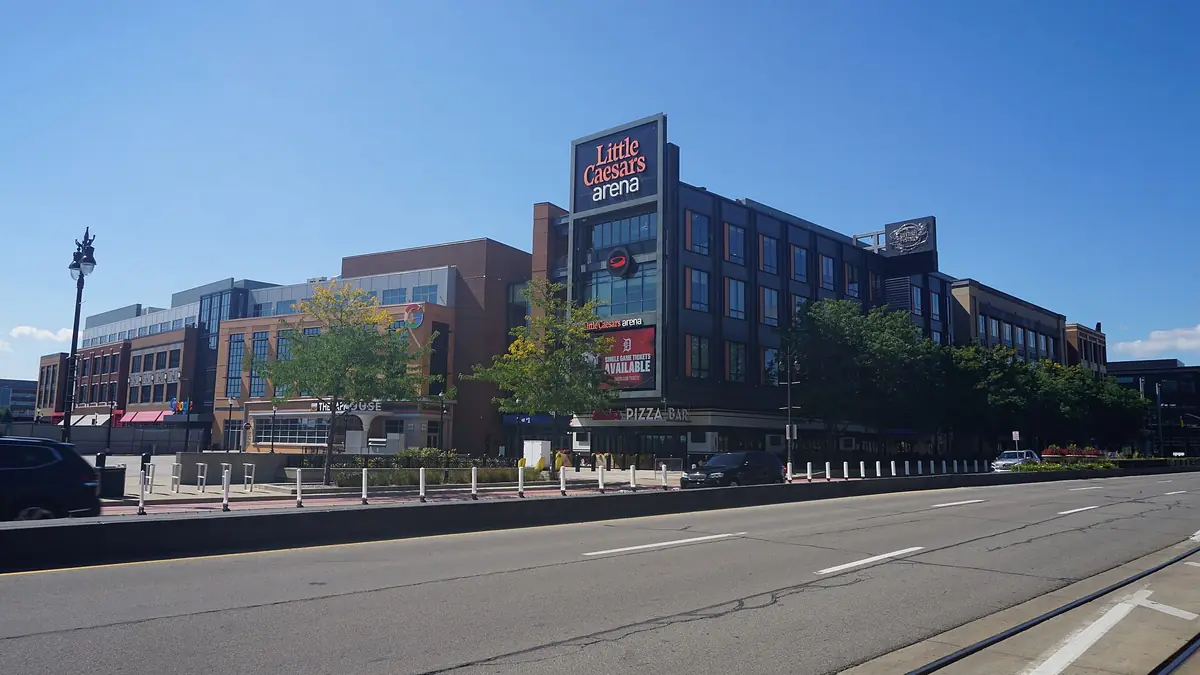
You will find the arena at 2645 Woodward Avenue, where downtown meets Midtown. The QLine, a 3.3-mile streetcar on Woodward, has a Sproat/Adelaide stop next to the building and another at Grand Circus Park; a state subsidy kept it fare-free as of 2026. Garages and lots surround the arena, and plenty of fans leave the car downtown and take the streetcar or walk up.
The District Detroit, the mixed-use neighborhood promised around the arena, was still largely unbuilt as of 2026. Pregame crowds collect in the arena's glass-roofed concourse, which runs like an indoor street, and along Woodward and in Midtown.
Under the venue's posted rules as of 2026, anything bigger than roughly a clutch or wallet, about 4 by 6 by 1.5 inches, stays outside. Only diaper and medical bags are exempt, and once you leave you cannot come back in. Rules change, so confirm on the arena's policy page close to game day. Reserved Seat orders ship free.
Cougars, the octopus and a 25-year playoff run
Detroit entered the league in 1926 under the Cougars name, switched to Falcons in 1930 and adopted Red Wings, along with the winged wheel, in 1932. It belongs to the Original Six, the clubs that made up the entire NHL between 1942 and 1967. Its 11 Stanley Cups (1936, 1937, 1943, 1950, 1952, 1954, 1955, then 1997, 1998, 2002 and 2008) are the most of any U.S.-based club. Homes before this one were Olympia Stadium and, from 1979 to 2017, Joe Louis Arena. The current arena opened September 5, 2017, and the Detroit Pistons of the NBA play there too.
- The octopus: the Cusimano brothers, Pete and Jerry, tossed one onto the Olympia ice on April 15, 1952, one arm for each of the eight playoff wins a Cup then required. Detroit swept both series. Al, a purple octopus, is the unofficial mascot.
- The 1950s and 1990s: Gordie Howe, Ted Lindsay and Sid Abel, the Production Line, drove the first dynasty; the Russian Five helped end a 42-year drought in 1997.
- The streak: 25 consecutive postseasons from 1990–91 to 2015–16, third on the NHL's all-time list. As of the 2025–26 season, the team had not made the playoffs since.
- The record crowd: 105,491 at Michigan Stadium for the January 1, 2014, Winter Classic, a 3–2 shootout win for Toronto.
The club has owned the Hockeytown trademark since 1996, and nine jersey numbers hang retired, including Howe's 9, Steve Yzerman's 19 and Nicklas Lidström's 5.
Frequently asked questions
Which Mezzanine seats have an obstructed view at Little Caesars Arena?
Guides point to the top rows of Mezzanine sections like 207, 216, 222 and 231, which sit beneath the gondola overhang. Front rows avoid the problem.
Where do the Red Wings shoot twice?
Guides differ slightly: one places it at the corner around section 112, another at the end near 115-116. Both point to the same end of the rink, so check the listing map.
Is the QLine free to Little Caesars Arena?
As of 2026, yes. The Woodward streetcar has a stop at Sproat and Adelaide, right next to the arena.
How big a bag can you bring to a Red Wings game?
Under the current policy, roughly clutch size, about 4 by 6 by 1.5 inches; diaper and medical bags are exempt. There is no re-entry, so check the policy before you go.
Where did the octopus tradition start?
At Olympia Stadium on April 15, 1952. Each arm represented one of the eight playoff victories a championship then took.
Sources
- Wikipedia – Detroit Red Wings
- Wikipedia – Little Caesars Arena
- Wikipedia – Legend of the Octopus
- Wikipedia – 2014 NHL Winter Classic
- Wikipedia – QLine
- RateYourSeats – Section 112, Little Caesars Arena
- RateYourSeats – Section 231, Little Caesars Arena
- TickPick – Red Wings seating chart
- 313 Presents – Little Caesars Arena venue policies
- Wikipedia – National Hockey League
- Wikipedia – List of Stanley Cup champions