

Row height matters more than section here
At a Big Ten football game, choose a sideline seat in the middle third of the bowl's height, between the 20-yard lines if you can. In this conference the row number often matters more than the section number, because the stadiums are so deep.
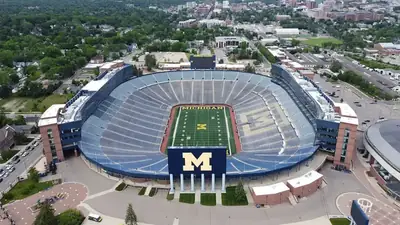
Michigan Stadium is the clearest example: some sections climb to row 98. A seat in row 20 and a seat in row 90 of the same sideline section are different experiences, one close and flat, the other high and distant. Middle rows give you both perspective on plays developing and enough closeness to follow the players. The low rows of an end zone in a 100,000-seat bowl are among the weakest seats in college football; a mid-height corner seat usually sees more of the field for less.
For basketball, the rule is simpler. Sideline seats 10 to 20 rows up give the best view in nearly every Big Ten arena. Seats behind the baskets cost less and show less, and are mainly worth it if you want to be near the student section.
Inside the three 100,000-seat stadiums
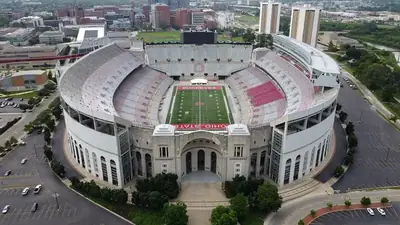
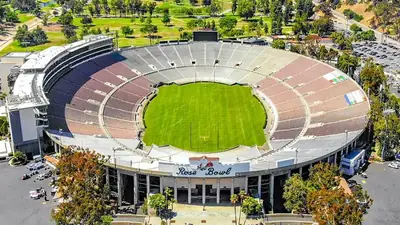
Three conference venues hold more than 100,000 fans: Michigan Stadium at 107,601, Penn State's Beaver Stadium at 106,572 (its listed figure) and Ohio Stadium at 102,780. Each has its own guide, with Michigan Stadium and Ohio Stadium covered in full and UCLA's home field covered on the Rose Bowl Stadium page.
- Low sideline rows: close to the bench and the noise, but the far side of the field compresses. Good for atmosphere, weaker for following a play.
- Middle sideline rows: the best overall balance. Pay for these if the game matters to you.
- Upper rows: a full tactical view, long walks and steep stairs. A sound budget choice for a non-conference game.
- End zones and corners: skip the lowest end-zone rows; mid-height corners are a fair value.
Allow time. Getting from parking through the gates at a stadium this size can take an hour, and the climb to an upper row adds more.
Eighteen members, New Jersey to Los Angeles
Founded in 1896, the Big Ten is the oldest conference in NCAA Division I. Its seven founders included Michigan, Minnesota, Wisconsin, Illinois, Purdue, Northwestern and the University of Chicago. The most recent expansion, effective August 2, 2024, brought in USC, UCLA, Oregon and Washington from the Pac-12, and the league dropped football divisions that same year.
- Atlantic side: Maryland Terrapins Football, Penn State Nittany Lions Football and Rutgers Scarlet Knights Football.
- Great Lakes core: Michigan Wolverines Football, Michigan State Spartans football, Ohio State Buckeyes Football, Indiana Hoosiers Football, Purdue Boilermakers Football, Illinois Fighting Illini football and Northwestern Wildcats football.
- Upper Midwest and Plains: Iowa Hawkeyes Football, Minnesota Golden Gophers football, Nebraska Cornhuskers football and Wisconsin Badgers Football.
- Pacific: Oregon Ducks Football, UCLA Bruins Football, USC Trojans Football and Washington Huskies Football.
Each school's page covers its stadium, its student section and where visiting fans sit.
Which Big Ten games sell out first
The conference protects several annual series, and they are reliably the tightest tickets of the season:
- Ohio State vs. Michigan, known simply as The Game, closing the regular season in late November.
- Michigan vs. Michigan State, played for the Paul Bunyan Trophy.
- Wisconsin vs. Minnesota, a border series between two founding members.
- Washington vs. Oregon, a Pacific Northwest rivalry that moved into the league whole.
Expansion created a second layer of demand. West Coast teams now make first trips to Midwest stadiums, and Midwest programs travel to Los Angeles, Eugene and Seattle. Schools with large national alumni bases often sell their West Coast road games well, so the visiting crowd can be sizable. If you are a traveling fan, expect to buy individually and sit scattered unless your school's allocation reaches you.
Indianapolis in December, then the bowls
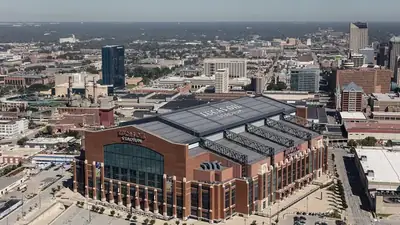
Lucas Oil Stadium in Indianapolis has hosted the Big Ten Football Championship Game since 2011, normally on the first Saturday of December, and is booked through 2028. Without divisions, the game now pairs the top two teams in the standings. Oregon beat Penn State 45–37 in 2024, and Indiana edged Ohio State 13–10 in 2025.
The retractable roof takes weather out of the decision, so focus on the angle: the lower-level and loge sidelines are the strongest seats in the building. Demand swings with the matchup and with what is at stake for the College Football Playoff. The pairing is usually settled the Sunday before, which squeezes most buying into one week.
The league's tie to the Rose Bowl Game goes back to 1947, though the playoff era has changed how often the traditional matchup appears. For the 2026 season, Big Ten teams also slot into the Citrus Bowl, the Music City Bowl and the Pinstripe Bowl, among others. Tie-ins are renegotiated in multi-year cycles, so read this as the current arrangement. College Bowl Games lists the full postseason.
Tournament week in Chicago, Indianapolis or Minneapolis
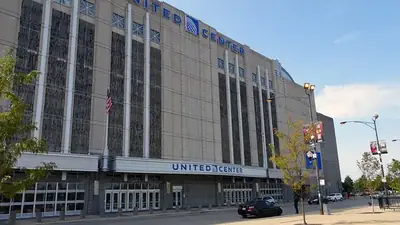
Big Ten basketball runs from November into March, and the men's tournament rotates among big arenas: Target Center in Minneapolis in 2024, Gainbridge Fieldhouse in Indianapolis in 2025, the United Center in Chicago in 2026, and Gainbridge again in 2027. Michigan State leads all schools with six tournament titles. Michigan won in 2025, and Purdue, seeded seventh, beat Michigan 80–72 for the 2026 title.
Tickets usually sell by session or as a package for the whole event. Chicago and Indianapolis are a drive away for many members, which pushes demand up for the later sessions. The West Coast schools change the picture slightly: their fans travel farther, so a session built around a Pacific-time team often has more resale supply.
Allocations, resale and November weather
Every university runs its own box office. Season tickets go first, usually tied to a donation level that sets seat location. Students draw from a separate pool, and each visiting school receives an allocation that it sells to its own donors and alumni. Public single-game sales come last, and for rivalry games there may be little or nothing left by then.
That is why most fans reach The Game, a top-10 showdown or a November night game through resale. Prices there follow records, playoff stakes, the forecast and the kickoff slot, which television partners often fix only a week or two out. A frigid forecast or an 8 p.m. start can bring more listings onto the market. Reserved Seat backs every order with a 100% guarantee.
- Dress for the cold. Late-season kickoffs in Madison, Minneapolis, Ann Arbor and State College can be well below freezing.
- Check the bag rule. Policies vary widely; as of the 2026 season, Michigan bans all bags, clear ones included. Confirm the school's current policy before you go.
The conference posts schedules and title-game details at bigten.org.
Frequently asked questions
What row should I pick in a 100,000-seat Big Ten stadium?
A middle row on the sideline is usually the best balance. Low rows flatten the far side of the field, and the top rows of a bowl as deep as Michigan Stadium, where some sections reach row 98, feel distant.
Which Big Ten rivalry is hardest to get into?
Ohio State vs. Michigan, known as The Game, is the toughest ticket on the calendar. Michigan vs. Michigan State, Wisconsin vs. Minnesota and Oregon vs. Washington also sell quickly.
When is the Big Ten Championship Game?
Usually on the first Saturday of December at Lucas Oil Stadium in Indianapolis, which has hosted since 2011 and is scheduled through 2028. It now matches the top two teams in the standings.
How many teams are in the Big Ten now?
Eighteen. USC, UCLA, Oregon and Washington joined on August 2, 2024, and the conference dropped football divisions the same year.
Where will the Big Ten basketball tournament be played?
The site rotates. Chicago's United Center hosted in 2026, and Gainbridge Fieldhouse in Indianapolis is scheduled for 2027.