

Upcoming Washington Wizards dates
Dates and live ticket listings appear here as soon as they are on sale. The guide below covers what to know before you buy.
Wizards seats worth the money
At Capital One Arena, the best Washington Wizards seat for watching basketball is a 100-level sideline seat about 10 to 20 rows up. The sleeper is a 200-level club seat on the sideline, which frequently outperforms the last rows of the lower bowl. The 400 level is the budget option; stay in its front rows near midcourt.
- Best view: 100-level sideline, middle rows.
- Smart alternative: 200-level club sideline.
- Value with care: 400-level front rows near midcourt.
- Skip: back rows of the 400-level end sections.
The building stands over a downtown Metro stop, and home games run from October to mid-April.
Capital One Arena's 100, 200 and 400 levels
Basketball capacity is 20,356. Fans sit in three tiers, with suite rings between them:
- Court level: courtside and floor seats sold under premium names.
- 100 level: around the court, sections roughly 100 to 121.
- 200 level: club sections, roughly 200 to 229, with their own concourse access.
- 400 level: the top tier, roughly 400 to 433.
These ranges come from fan seat-view maps and are approximate. The Wizards bench side is not confirmed here, so check the seat map on your listing.
Courtside to the 400s: what each seat gives up
Courtside
The priciest tickets in the arena, and a proximity play. Down at court height, depth at the opposite basket disappears; you are paying for the moment, not the sightline.
Lower-level sideline and corners
Middle rows on the sideline show ball movement and spacing while keeping the bench close. Corner sections trim the price and keep an angled look at both hoops.
200-level club
Low enough to feel part of the game, high enough to take in the whole court at once, plus a private concourse. A sideline club seat is often a better view than a back row in the 100s.
400 level
The lowest-priced tier and a long climb. Sideline front rows are fine for following play; back rows at the ends are the weakest basketball seats in the building. If the choice is a corner's last row or a front row closer to center, pick the front row every time.
Busy nights at Capital One Arena
Like every NBA club, Washington plays a handful of preseason games in early October, then an 82-game slate split evenly home and away through mid-April. Postseason play, starting with the play-in round, can stretch into June.
- Big-name visitors. Star-led opponents such as Los Angeles, Golden State and Boston bring the biggest crowds, many wearing the other team's colors.
- Old Eastern rivals. The Celtics, Knicks, Cavaliers and Bulls all have postseason history with this franchise.
- Weekend and holiday dates. Fridays, Saturdays and holiday weeks go first.
- A shared building. The arena is also home to the Capitals of the NHL, and back-to-back Wizards and Capitals dates fill downtown hotels and restaurants.
The easy nights are midwinter weeknights against a Western Conference team with no headliner. Those are the games to splurge on a lower-level seat you might not try otherwise.
Gallery Place, arena entrances and the backpack ban
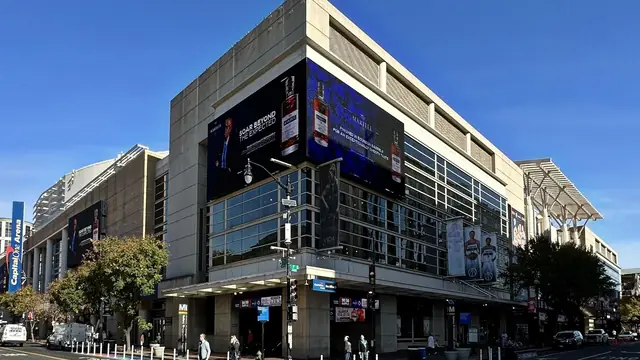
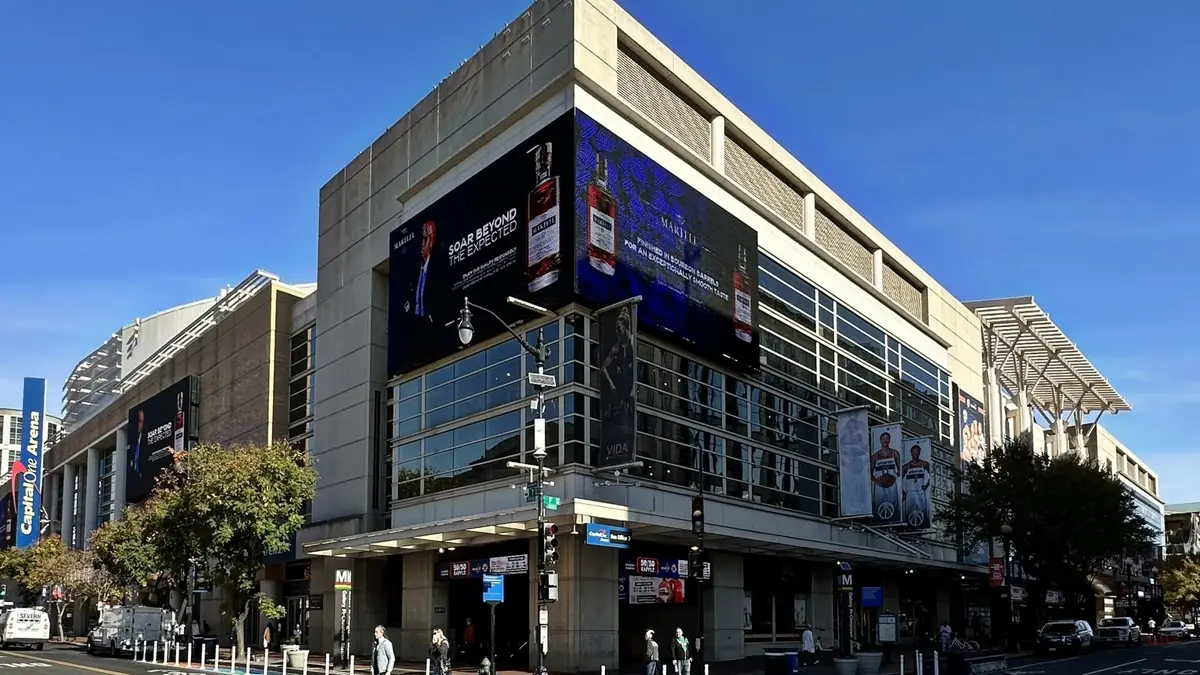
Look for 601 F Street NW, on the line between Chinatown and Penn Quarter. Metro's Gallery Place station sits right below the building, serves the Red, Green and Yellow lines, and opens straight into the arena. Riding is generally quicker than driving, because garages fill and traffic stalls before tipoff. Street-level entrances include F Street and 7th and G Streets.
Backpacks have been off limits since the 2019 to 2020 season, and the rule has since tightened. As of October 2026, the arena's posted policy bars bags, backpacks and purses entirely, apart from clutches up to 4 by 6 inches and medical or parenting bags up to 14 by 14 by 6 inches, which are screened and should come through the 6th and F entrance. Rules change, so read the arena policies before you go. Orders through Reserved Seat include free shipping.
Staying in the District through 2050
The arena nearly lost its tenants. A December 2023 announcement would have sent both the Wizards and the Capitals across the river to Alexandria, Virginia, but the Virginia deal was dead by March 2024. Mayor Muriel Bowser followed with an agreement that holds both teams in Washington through at least 2050. In return, the District is putting 515 million dollars toward a roughly 1 billion dollar overhaul of the building, which is supposed to wrap up in 2028. In August 2026, Capital One extended its naming rights for 20 years.
What that means for you: some concourses, clubs and amenities may be closed or relocated during construction seasons, so confirm what is open for your game.
From the Chicago Packers to the 1978 title
Few franchises have moved and renamed as often. It started in Chicago in 1961 as the Packers, the league's first expansion club, and was renamed the Zephyrs a year later. Baltimore took the team in 1963 and called it the Bullets. A 1973 move to the Washington suburbs produced one season as the Capital Bullets before Washington Bullets stuck in 1974. Games were played at the Capital Centre in Landover, Maryland, until December 1997, when the downtown building opened as the MCI Center (it was the Verizon Center later on).
- The Bullets' peak: Wes Unseld, league MVP in 1969, was the foundation for more than ten years, with Elvin Hayes supplying the points. The franchise played for the title four times in nine years: 1971, 1975, 1978 and 1979.
- 1978: a 44 and 38 team coached by Dick Motta took Seattle to a seventh game and won it. Unseld was named Finals MVP, making him the only player in team history to hold both MVP trophies.
- The rename: Abe Pollin decided in November 1995 to retire the Bullets name. He pointed to the city's struggles with crime and to the killing of his friend Yitzhak Rabin, the Israeli prime minister, and said the name sounded violent. Wizards became official on May 15, 1997.
- Michael Jordan: president of basketball operations from January 2000, then a player from 2001 to 2003.
- Arenas, then Wall and Beal: Gilbert Arenas arrived in 2003 and had the team back in the playoffs by 2005. Later, John Wall and Bradley Beal took Washington to the postseason several times between 2014 and 2017 and won the Southeast Division in 2017.
Ted Leonsis bought the team in June 2010 and owns it through Monumental Sports & Entertainment. The retired numbers are 10, 11, 25, 41 and 45.
Frequently asked questions
Are 200-level club seats good for a Wizards game?
Yes. The club tier is close enough to feel the game and high enough to take in all four corners of the floor, and it has its own concourse. A sideline club seat often beats a back row of the 100 level.
Which Wizards seats should I avoid?
The back rows of the 400-level end sections are the weakest for basketball. Moving to the front of the same tier, nearer center court, is a big upgrade.
Can I bring a purse into Capital One Arena?
As of October 2026, only clutches up to 4 by 6 inches, plus screened medical or parenting bags up to 14 by 14 by 6 inches. Check the arena policy page before you go.
Do I need to drive to a Wizards game?
No. Gallery Place, served by Red, Green and Yellow Line trains, is right under the arena, with its own entrance, and it is usually faster than driving downtown.
When did the Wizards win their championship?
In 1978, while still called the Bullets. They won a seven-game Finals against Seattle, and Wes Unseld was Finals MVP.
How long will the Wizards stay at Capital One Arena?
Through at least 2050, under its agreement with the District, along with a renovation targeted for completion in 2028.