

Upcoming Toronto Raptors dates
Dates and live ticket listings appear here as soon as they are on sale. The guide below covers what to know before you buy.
Raptors seats, ranked
Home for the Toronto Raptors is Scotiabank Arena, and the seat most fans should target is a 100-level sideline section about rows 10 through 20. Sitting there lifts you above the players' heads so you can see spacing and rotations, yet keeps faces in view. For value, take the first few rows of a 300-level sideline section, which see the entire court without obstruction.
- 100-level sideline, mid-rows: view and atmosphere in equal measure.
- 100-level corners near the baseline: a smart compromise on price.
- 300-level sideline, front rows: the value choice.
- Courtside: the experience seat, not the tactical one.
- Last rows of the 300-level ends: the weakest seats for basketball.
Regular-season games run October through April.
The two-tier bowl on Bay Street
Capacity is 19,800 for a basketball game, rising to 20,511 when standing room is sold. The bowl has two seating tiers with suites sandwiched between:
- Floor: courtside seats on the court level itself.
- 100 level: the lower ring, about sections 101 through 122.
- Suites: the middle band of the building.
- 300 level: the upper ring, roughly sections 301 to 324.
Those ranges come from fan seat-view maps and are a guide, not gospel. The Raptors bench side is not confirmed here, so check the seat map on your listing.
Trade-offs from courtside to the 300s
Courtside
You hear the players and coaches and sit at the top of the market. From floor level, though, plays at the far end lose their shape. Buy it for the moment, not the analysis.
Lower-level sidelines
Center-court sections cost the most; sections toward the corners cost less and still feel close. The mid-row height is what makes these seats work.
Behind the baskets
These usually undercut the sideline at an equal height. Depth flattens, so judging shots at the far basket is harder, and the stanchion can interrupt the lowest rows. Higher rows in those end sections see over the clutter and are a fair budget pick.
The 300 level
This is where families and groups usually find room. Sideline front rows show the full court and the scoreboard. In the end sections, the last rows are the seats to skip; a small step up in price buys a seat nearer midcourt or the front.
Which Raptors dates are hardest to get
Each NBA team plays 82 games, 41 at home, from October to April, after a short preseason in early October. The play-in tournament and playoffs begin in mid-April and run into June.
- Star-driven visitors. The Lakers, Warriors and Celtics, and any team with a national headliner, draw the heaviest resale demand.
- Atlantic Division games. The Celtics, Knicks, Nets and 76ers matter in the standings, and the 2001 and 2019 playoff series gave the 76ers matchup real history.
- Weekends and holidays. Friday and Saturday games and holiday-week dates sell tighter than January and February weeknights.
- Playoffs. Since the 2019 run, home playoff games feel like citywide events, and prices track the series score closely.
Midweek games against Western Conference teams out of contention are the easiest way in, especially in the 300 level.
Union Station, the PATH and the small-bag rule
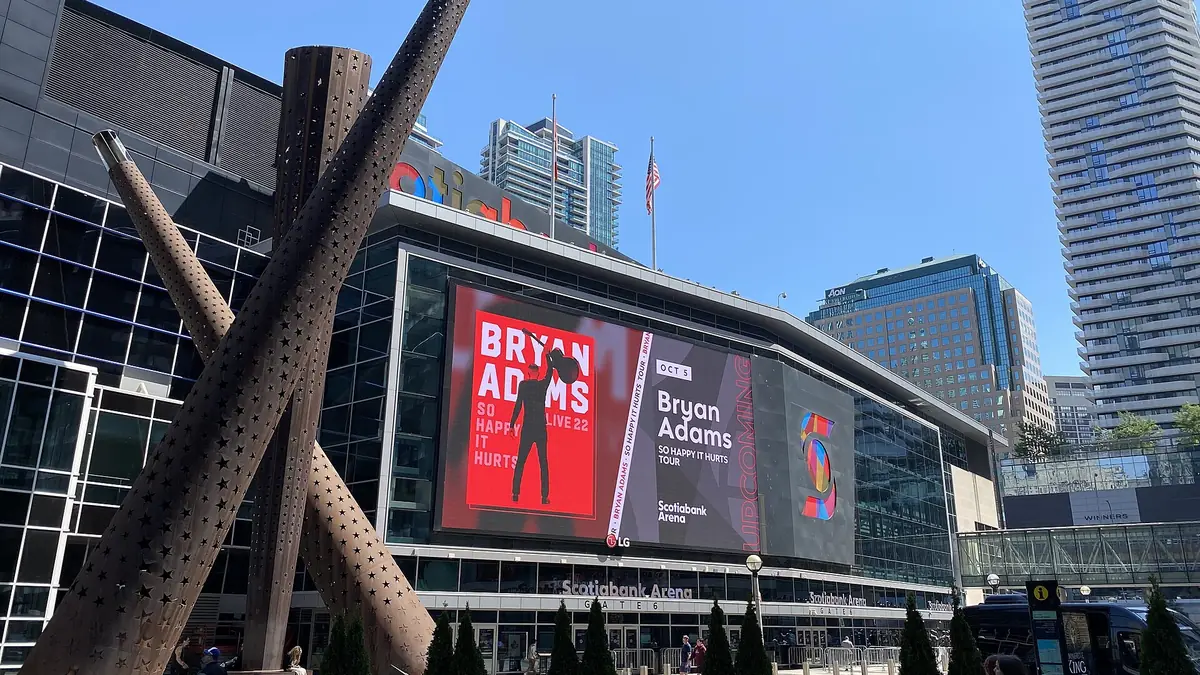
Located at 40 Bay Street at the foot of downtown, the arena connects to Union Station underground via the PATH. Union is the stop for TTC Line 1, GO Transit trains and the UP Express from the airport, so transit is the easy answer, and on a cold night you can reach your gate without going outside.
Do not plan on parking at the building: its own spaces go mainly to tenants and suite holders. A public garage sits under Maple Leaf Square, entered at 15 York Street, and it and the surrounding downtown lots tend to be full well before tip-off.
The bag rule is one of the strictest in the league. As of the 2025 season, the arena admits a small purse, clutch or fanny pack no larger than roughly 6.5 by 4.5 inches (16.5 by 11.5 centimeters), and nothing bigger. Bring a card or phone, since the building does not take cash. Every Reserved Seat order carries a 100% guarantee. Bag rules change, so check the arena's bag policy before you go.
Jurassic Park and a national fan base
Outside the arena, Maple Leaf Square has a giant screen. In the playoffs, fans pack it as Jurassic Park, a free outdoor viewing party. Without a ticket to a big game, that is the place to be, but arrive early: there are no reservations and it fills up.
When the Grizzlies left Vancouver for Memphis in 2001, Toronto became the league's lone team outside the United States, and the crowd reflects it: many fans travel from across Canada and build a weekend around a game. The team's "We the North" marketing leans into that role. The shortest road trips run to Detroit, Cleveland and New York.
From SkyDome to the 2019 parade
Toronto won its expansion bid on November 4, 1993, paying what was then a record 125 million US dollars. Fans submitted over 2,000 name ideas, and Raptors was announced on May 15, 1994, with the velociraptor still fresh from the 1993 film Jurassic Park. Opening night, November 3, 1995, ended in a 94 to 79 win against the New Jersey Nets. Maple Leaf Sports & Entertainment owns the team, along with the NHL's Maple Leafs.
For their first few seasons the Raptors made do in a ballpark, SkyDome (today's Rogers Centre), until the Air Canada Centre opened in February 1999. That building became Scotiabank Arena in 2018.
- Vince Carter era: acquired on 1998 draft night, he took the 2000 Slam Dunk Contest, then carried Toronto past the Knicks in 2001 for its first series win; Philadelphia ended that run in seven.
- Chris Bosh: drafted in 2003, the centerpiece until 2010.
- DeRozan and Lowry: perennial postseason teams through the mid-2010s; Masai Ujiri took over the front office in 2013.
- 2019: a July 18, 2018, trade brought in Kawhi Leonard. His corner jumper at the horn of Game 7 against Philadelphia was a playoff first, the only Game 7 won on a buzzer-beater at that point, and he was Finals MVP in a 4 to 2 series win over Golden State.
- 2020 to 2021: COVID-19 border rules sent home games to Amalie Arena in Tampa, Florida.
Division banners hang from 2007, 2014 through 2016, and 2018 through 2020, seven in all.
Frequently asked questions
Which rows are best in the Raptors lower bowl?
Along the sidelines, roughly rows 10 to 20 of the 100 level give enough height to see the whole floor while keeping you close to the players.
Can I reach Scotiabank Arena without going outside?
Yes. The PATH underground network connects Union Station to the arena, so fans arriving by TTC, GO Transit or the UP Express can walk in under cover.
Is there parking at the arena for Raptors games?
Very little. The arena's own spaces go mostly to tenants and suite holders, and the public garage under Maple Leaf Square fills early on game nights. Transit is the better plan.
Why are they called the Raptors?
Fans chose it. Over 2,000 suggestions came in, and the winner was announced in May 1994, soon after the 1993 film Jurassic Park made velociraptors a pop-culture hit.
Where did the Raptors play in 2020-21?
COVID-19 border restrictions moved their home games to Amalie Arena in Tampa, Florida, for that season.
How big a bag can I bring to a Raptors game?
Very small. The 2025-season limit was a purse, clutch or fanny pack of roughly 6.5 by 4.5 inches. Rules change, so double-check with the arena.