

Upcoming Anaheim Ducks dates
Dates and live ticket listings appear here as soon as they are on sale. The guide below covers what to know before you buy.
Your Ducks seat in 30 seconds
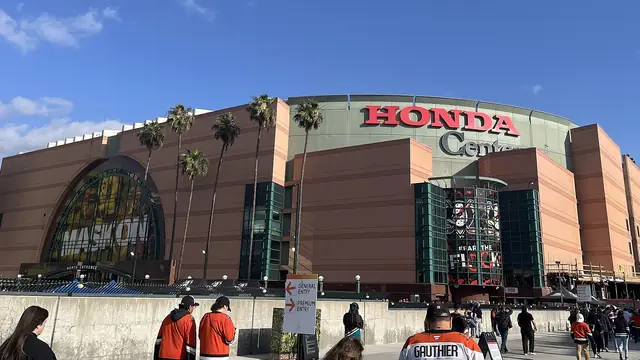
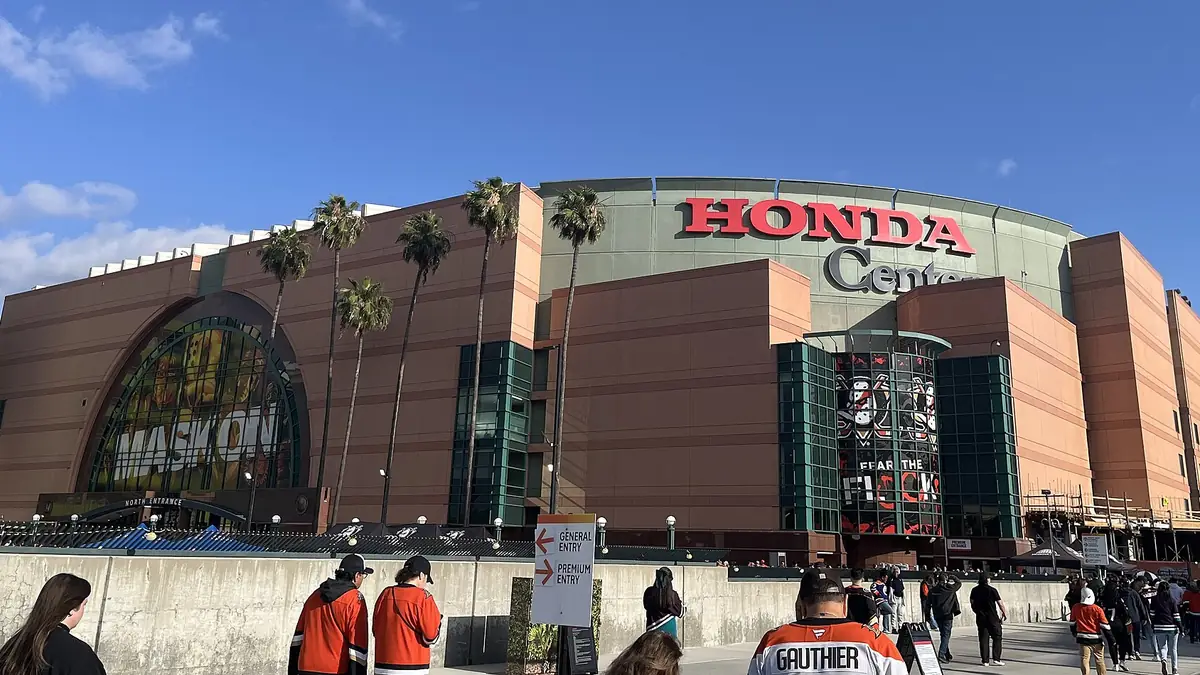
For an Anaheim Ducks game, the first choice is a Plaza Level sideline seat near center ice, sections 208 or 222, about rows 6 to 12. Honda Center, home ice since the club's first season, seats 17,174 for hockey, and its lower bowl is shallow, so those rows sit close to the boards yet high enough to read plays at both ends.
- Want more Ducks goals in front of you: sit at the end near section 214.
- Want comfort and short lines: the Club Level, in the 300 sections.
- Want the lowest cost with a full view: low Terrace rows (the 400 sections) near center ice.
- Skip if you can: the top corners of the Terrace.
Regular-season hockey here starts in October and wraps up in April; playoff rounds stretch into June.
Plaza, Club or Terrace: matching the level to the night
The arena has three public seating rings, all dating in some form to its June 1993 opening.
Plaza Level (sections 201–228)
The lower bowl. Rows run from A to S, fewer than 20 deep, so even the back row stays reasonably close. Seating guides put center ice at sections 208 and 222. These seats carry the highest demand.
Club Level (the 300 sections)
The premium middle ring: roomier chairs, lounges, quicker concessions and food brought to you. The angle is a little higher than the Plaza and shows the whole rink. It suits a client evening or a family that wants an easy night.
Terrace Level (the 400 sections)
The upper bowl and the budget tier. From the low rows near center ice you see line changes, power-play setups and breakouts as patterns, which some fans prefer to the Plaza. The view weakens as you climb into the corners.
Exact section ranges for the Club and Terrace levels were not confirmed in this page's sources, so check the map attached to each listing.
Glass rows, attack ends and the corners to skip
- Row A, the glass: the closest seat in the building, with the noise of hits and the warmup up close. At ice level, though, the far end of the rink flattens out. Buy it for the experience, not to follow the game.
- The end near section 214: Anaheim shoots at this goal for two of the three periods (the first and third), per seating guides. End seats here cost less than the sideline and put you near most home goals.
- Top Terrace corners: far from the ice at an awkward angle. If the budget allows, step down to the low Terrace rows or the back of the Plaza.
- Middle of a long row: in a full house, an aisle seat saves you from squeezing past a dozen people for a mid-period break.
Bench locations were not confirmed in the sources for this page, so do not buy a section on the assumption that it sits behind the Ducks bench.
Ducks dates with the thinnest supply
Exhibition games come in September; the 82 games that count run from the start of October to the middle of April; the postseason comes after. The Ducks list April 6, 2027, as their final regular-season home date for 2026–27.
- Los Angeles Kings: the Freeway Face-Off. Kings fans drive down in numbers, and these dates go first.
- Original Six clubs: Boston, the Rangers, Detroit, Chicago, Toronto and Montreal bring transplanted fans who live in Southern California.
- Canadian visitors: Edmonton, Calgary and Vancouver supporters like a winter trip south, which lifts those nights.
- Fridays, Saturdays and the holidays: weekend and late-December games sell ahead of midweek dates.
- Promotion nights: the team says more than 20 home games a season feature a giveaway or theme.
Resale prices track the opponent and the standings. For a good Plaza seat at a sensible price, look at midweek games against teams outside the division.
Taking the train to Katella Avenue
Few NHL buildings are this easy to reach by rail. Across the street is ARTIC (the Anaheim Regional Transportation Intermodal Center), a stop for Pacific Surfliner trains, the Metrolink Orange County Line and local OC Bus service. The Ducks Team Store now operates inside the ARTIC building. Check return train times before a late game.
If you drive, the team warns that redevelopment around the arena, known as the OCVIBE district, keeps shifting where you park and how you get in. Pay for parking ahead; parking gates generally open an hour before doors.
- Doors: generally 90 minutes before puck drop, two hours for some premium areas.
- Tickets: for 2026–27, mobile only through the team app. Screenshots and printed codes are refused.
- Bags: small bags only, no backpacks of any size and no bag check. The two published limits disagree: 4 x 6 x 1.5 inches in the arena's rules and 5 x 9 x 2 inches in the team guide, so carry the smallest bag you own. Confirm the rule close to game day.
- Re-entry: not allowed once your ticket is scanned.
Reserved Seat backs every order with a 100% guarantee.
Honda Center through 2027: construction and names
The City of Anaheim owns the arena. An upgrade of roughly 1 billion dollars, made public in April 2025 and due to wrap up by 2027, brings a new south entrance, escalators, club suites and more parking tied to OCVIBE. Expect detours and moved entrances while the work goes on, and look up current gates and parking on the Honda Center site.
Older fans may still call it the Pond: its first name was Arrowhead Pond of Anaheim, and it took the Honda Center name in 2006. It stands northeast of Angel Stadium, roughly three miles from Disneyland Park, so a game pairs easily with a theme-park trip.
Disney's Mighty Ducks, a 2007 Cup and the names in the rafters
Disney launched the franchise in 1993 under the Mighty Ducks of Anaheim name. The Samueli family took over in 2005, and the next year it became the Anaheim Ducks. The team plays in the Pacific Division of the Western Conference.
- 2003: a first trip to the Stanley Cup Final went the full seven games before New Jersey won it, but goaltender Jean-Sebastien Giguere still won the Conn Smythe Trophy as playoff MVP.
- 2006–07: a 12–0–4 start, an NHL record for an unbeaten opening, and the franchise's only Stanley Cup, clinched 6–2 over Ottawa at home on June 6, 2007. Defenseman Scott Niedermayer took the Conn Smythe.
- 2006–07 to 2016–17: half a dozen division banners.
- 2015 to 2019: the club retired Teemu Selanne's 8, Paul Kariya's 9 and Scott Niedermayer's 27.
Seven Hall of Famers have played for the franchise: Selanne, Kariya, Niedermayer, Pronger, Fedorov, Kurri and Oates. For this season's roster and dates, see the Ducks' team site.
Frequently asked questions
Which end do the Ducks attack twice at Honda Center?
Per seating guides, the goal by section 214 is the one Anaheim attacks in periods one and three. Watch warmups to confirm on the night.
How many rows are in the Honda Center lower bowl?
Rows A through S, so under 20. Even the last Plaza row is not far from the boards.
Is the Terrace Level worth it for a Ducks game?
Low Terrace rows near center ice are a strong value because you see the whole rink. The top corners are the seats to avoid.
Which train station serves Honda Center?
ARTIC, directly opposite the arena. Metrolink, the Pacific Surfliner and OC Bus all stop there.
What bag can you bring to a Ducks game?
A small one only. No backpacks, and nowhere to check a larger bag. The arena and the team publish different size limits, so bring the smallest bag possible and check the current rule.